

A flyable airplane made mostly from cardboard sounds like a novelty, but YouTuber and engineer Peter Sripol demonstrated that it can come surprisingly close to real, human carrying flight.
The project centered on a simple question: can cardboard, a material known for being cheap, light, and fragile, generate enough lift to get a person airborne. Sripol scaled up techniques commonly used in radio controlled aircraft and applied them to a full size, sit in airplane built largely from flat sheets of cardboard.
The fuselage and wings were skinned in cardboard, with limited plywood reinforcement added at critical load points, especially where the wings joined the body. Throughout the build, Sripol relied on constant iteration, strengthening areas that flexed too much and shaving off weight wherever possible. Cardboard proved workable but unforgiving, forcing careful engineering decisions at every step.
Ground testing began with taxi runs and acceleration tests on a field. Sripol sat inside the aircraft and controlled it remotely, using a foot pedal to release the undercarriage. Early attempts revealed unexpected challenges, including rolling resistance from tall grass. Even small details mattered, down to removing clothing to reduce weight.
After repositioning to smoother ground, the aircraft began showing signs of lift, with the nose briefly rising during high speed runs. For the final attempt, Sripol added a tow assist using a car to bring the aircraft up to speed before releasing the sled beneath it.
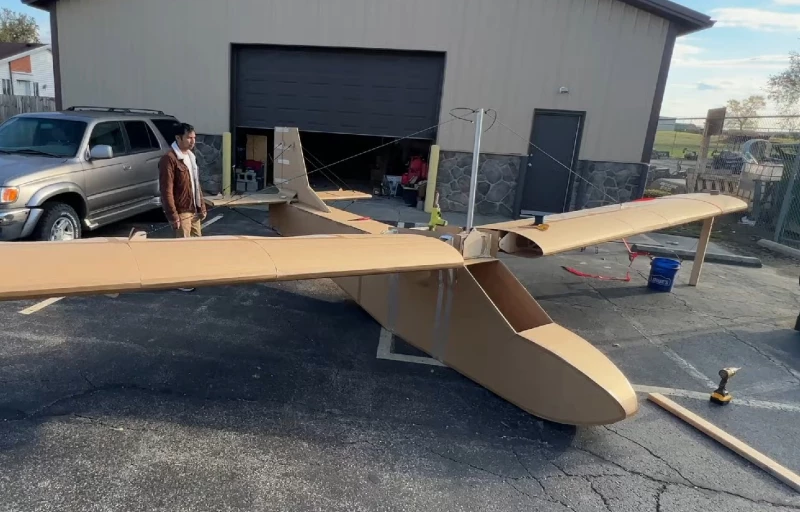
The fuselage and wings are fashioned from cardboard, though ply supports are included throughout (Peter Sripol/YouTube)
The result was a short but genuine moment of flight. The cardboard plane lifted off, stayed airborne for a few seconds, and then settled back into the field with a gentle crash. While brief, it confirmed that the design was capable of overcoming gravity, if only momentarily.
Sripol considers the experiment a success and plans to refine the design further using data from the tests. The project pushed an everyday material to its limits and highlighted exactly where physics, weight, and structure begin to outweigh ingenuity.


