

South Korea’s Hyundai Rotem has officially embarked on developing its most advanced combat vehicle to date—the K3 main battle tank. It is launched in close partnership with the Agency for Defense Development (ADD) and the Defense Agency for Technology and Quality. Designed as a successor to the formidable K2 Black Panther, the K3 is set to enter production by 2040 and will introduce revolutionary technology to the modern battlefield.
At the heart of the K3 program is a dramatic shift in battlefield mobility. The tank is South Korea’s most ambitious armored platform yet and is expected to be the world’s first main battle tank powered by hydrogen fuel cells. Early iterations will feature a dual-mode propulsion system combining hydrogen and diesel, eventually transitioning to a fully hydrogen-powered model. This new powertrain is projected to offer key tactical advantages including substantially lower acoustic and thermal signatures, improved operational endurance, and enhanced mobility making it harder to detect and more capable in high-stakes combat scenarios.
Hyundai Rotem described the K3 as “surpassing all capabilities of today’s MBTs,” highlighting how future battlefields demand not only more firepower but also superior command-and-control integration and survivability.
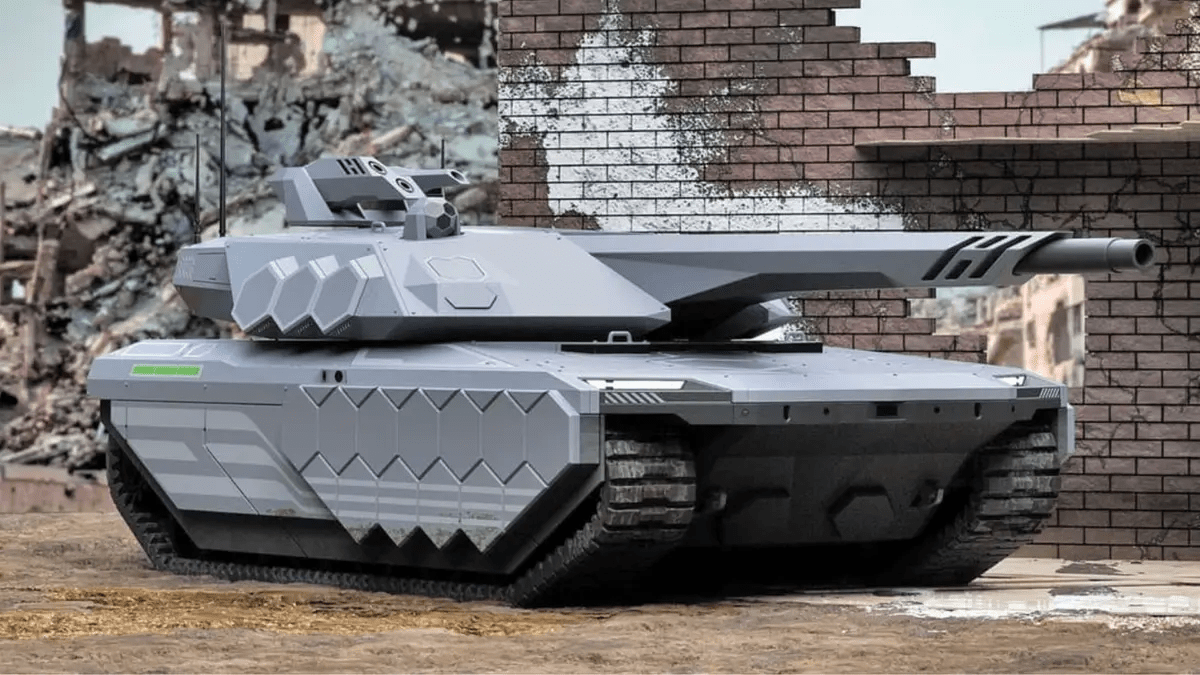
The K3’s firepower is anchored by a 130mm smoothbore main gun mounted on an unmanned turret. This weapon system, engineered for long-range lethality, will be guided by an AI-enhanced fire control system capable of autonomous target acquisition and engagement. This will enable preemptive strikes and rapid targeting in connected combat environments. Supplementing the main cannon are multi-purpose anti-tank guided missiles (ATGMs), with effective engagement ranges of up to eight kilometers. These missiles will support both line-of-sight and beyond-line-of-sight operations.
To bolster close-range defense, the K3 will be outfitted with a remote weapon station configurable for calibers between 12.7mm and 30mm. Inside, the tank will house a three-person crew—driver, gunner, and commander within an armored capsule isolated from the ammunition compartment. This layout, inspired by Western designs like the Israeli Merkava and Germany’s KF-51 Panther, enhances crew survivability by minimizing the risk from internal explosions.
In terms of defensive technology, the K3 will integrate advanced electronic countermeasures. Directional Infrared Countermeasures (DIRCM) will protect against heat-seeking missiles, while an Active Protection System (APS) will intercept incoming threats. A dedicated drone-jamming suite will offer protection against surveillance and loitering munitions crucial for survival in contested, drone-heavy battle zones.

Hyundai Rotem is also applying stealth-oriented design principles to the K3, incorporating radar-absorbent materials and reduced-signature geometry akin to the Polish PL-01 concept. The tank’s modular armor system, composed of layered ceramic, composite, and steel elements, will provide scalable protection that can be adjusted depending on mission profiles.
Looking toward future warfare, the K3 will feature autonomous driving modes and deployable reconnaissance drones often referred to as “slave drones” to scout the battlefield and identify threats before they materialize. These innovations align with South Korea’s strategic move toward roboticized and AI-assisted ground forces capable of operating within multi-domain combat frameworks.


 and the Defense Agency for Technology and Quality. Designed as a successor to the formidable K2 Black Panther, the K3 is set […]&media=https://wonderfulengineering.com/wp-content/uploads/2025/07/image-215.png)