

Image Courtesy: Cellula Robotics
A Canadian robotics company has demonstrated a major leap in underwater autonomy with a submarine drone completing a long range mission powered entirely by hydrogen fuel cells. The vehicle, known as Envoy AUV, traveled more than 1250 miles underwater without surfacing, marking one of the longest fully submerged missions of its kind.
The drone was developed by Cellula Robotics and completed a 385 hour mission that included thousands of maneuvers rather than a simple straight line route. This makes the result more representative of real world operations, where underwater vehicles must constantly adjust course and respond to changing conditions, according to an official press release.
Unlike traditional battery powered systems, the Envoy uses hydrogen fuel cells to generate electricity during operation. This allows it to sustain long missions while producing only water as a byproduct. The system was supplied by Infinity Fuel Cell and Hydrogen, which specializes in advanced energy solutions for aerospace and subsea applications.
The vehicle measures around 8.5 meters in length and is designed for flexibility, with configurations that can be adapted for different mission types. During its test run, it performed more than 4000 turns and maneuvers, highlighting its ability to operate in complex underwater environments such as seabed mapping, infrastructure inspection, and environmental monitoring.
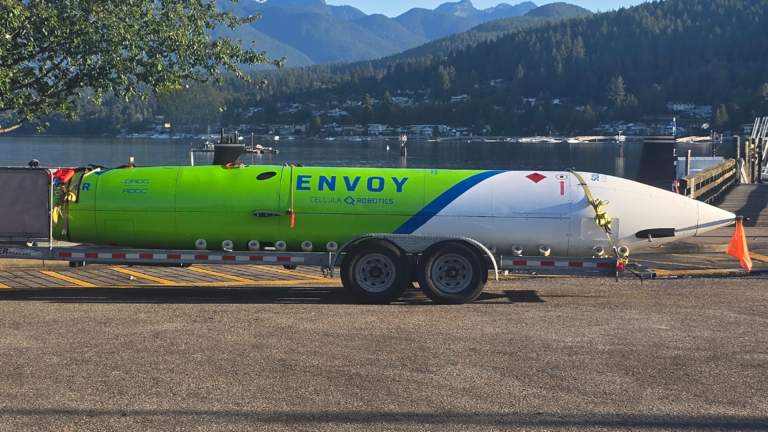
Envoy measures 27.9 feet in length, 3.3 feet in diameter, and has a displacement of approximately 8,160 lbs. Image credit: Cellula Robotics
Extended endurance is a key advantage for underwater operations. Traditional systems often require frequent recovery and redeployment, which can be costly and time consuming, especially in offshore environments. By staying submerged for longer periods, the Envoy can reduce interruptions and collect more continuous data.
The drone is also equipped with features such as a suction anchor, allowing it to attach to the seabed for stationary monitoring tasks. This expands its potential use cases to include long term observation, scientific research, and security related operations.
The successful mission demonstrates how hydrogen fuel cell technology can extend the capabilities of autonomous systems beyond the limits of conventional batteries. As demand grows for persistent underwater monitoring and exploration, such systems could play a larger role in both commercial and research applications.


