

When astronomers first spotted Earendel with the Hubble Space Telescope in 2022, it was hailed as the most distant star ever observed, located about 12.9 billion light years away. But new data from the James Webb Space Telescope is making scientists rethink that record-breaking discovery. Instead of being a single, massive star, Earendel might actually be a tightly packed cluster of stars.
The find was detailed in The Astrophysical Journal after Webb delivered higher-resolution spectra of the object. According to researchers, some of the light signatures looked more like those seen in ancient globular clusters than those of a lone star. That’s a big shift, because clusters behave very differently from individual stars when it comes to formation, brightness, and lifespan.
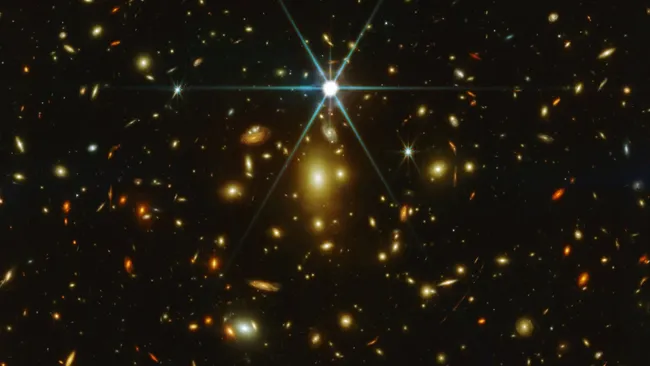
Image credits: NASA
When Earendel was first identified in the Sunrise Arc galaxy, scientists believed it represented a single, extraordinarily bright star that had formed less than a billion years after the Big Bang. If it were truly a star, it would have been an unprecedented window into the first stellar generations. But if it’s really a cluster, it still remains scientifically important—it would provide evidence that even in the earliest days of the universe, stars were already gathering into dense groups.
The challenge is that Earendel’s visibility relies on gravitational lensing, where the light is magnified by the gravity of an intervening galaxy cluster. This makes the object bright enough for telescopes to see, but it also distorts the image. Disentangling whether the light is from one star or many requires extremely careful modeling.
Astronomers are now looking for subtle variations that could reveal its true nature. For example, in a cluster, individual stars can cause microlensing events, where the brightness flickers slightly. Detecting those small changes could confirm that Earendel is more than one source. Researchers are also analyzing spectral fingerprints that might indicate a mix of stellar types rather than the uniform signal expected from a single giant star.
Even if the name “most distant star” no longer applies, the implications are still huge. Finding what could be a cluster at that distance means scientists can study the formation of compact stellar systems far earlier in cosmic history than previously thought. Webb’s precision has turned what once looked like a solitary beacon into something potentially more complex—and that complexity may end up teaching us even more about how the universe built its first structures.


