

Turkey has reached a major aviation milestone after its defense firm Baykar announced that two Kizilelma unmanned fighter aircraft successfully performed the world’s first fully autonomous close formation flight between combat capable jet powered drones. The test, conducted in Turkish airspace on December 28, 2025, was completed without any human control, relying entirely on onboard artificial intelligence, sensors, and real time data sharing, as reported by Army Recognition.
The achievement marks a turning point in unmanned combat aviation. Autonomous close formation flying is considered one of the most complex challenges in aerospace, especially at high subsonic speeds where precision, synchronization, and collision avoidance are critical. Until now, no country had publicly demonstrated two armed, fighter class unmanned jets maintaining tight formation under full autonomous control.
First unveiled in 2022, the Kizilelma is designed for contested airspace operations rather than traditional surveillance roles. It incorporates stealth shaping, internal weapons bays, advanced AI driven flight control, and beyond line of sight communications. Powered by a single turbofan engine, the aircraft has a maximum takeoff weight of around 6,000 kilograms and is designed to operate both from land bases and short takeoff vessels such as the Turkish Navy’s TCG Anadolu.
Defense analysts say the autonomous formation flight lays the groundwork for future operations involving coordinated swarming, mutual support, and manned unmanned teaming. The successful demonstration shows that Kizilelma’s autonomy suite can handle dynamic path planning, cooperative behavior, and real time risk management, all essential for next generation network centric air combat.
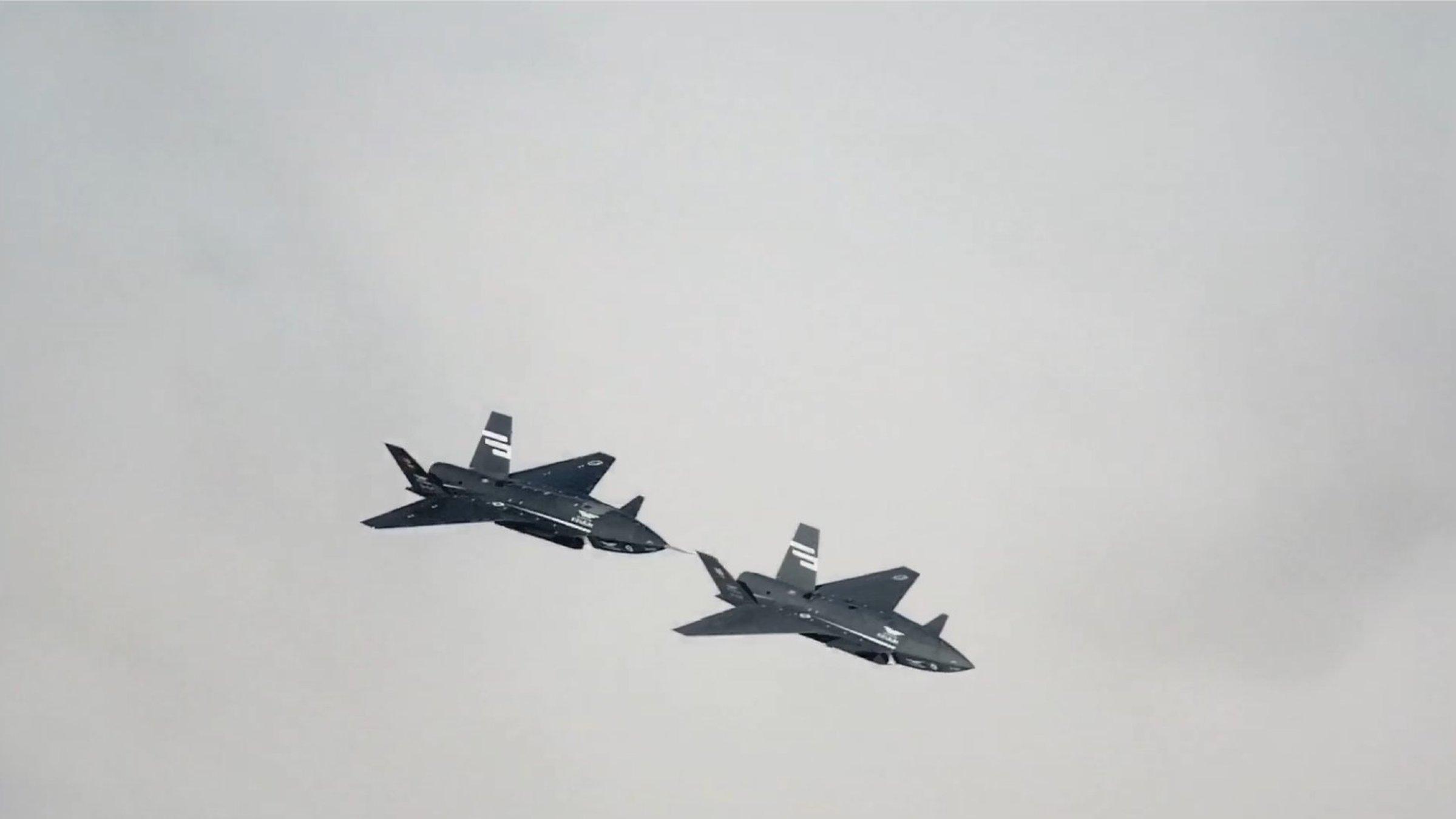
Courtesy: Baykar
While programs in the United States and China continue largely behind closed doors or remain in developmental phases, Baykar’s public test places Turkey at the forefront of autonomous fighter aviation. The milestone supports Ankara’s broader push toward defense self reliance and positions the country as a potential exporter of advanced unmanned combat aircraft.
The Kizilelma program is now entering its advanced flight testing phase, with serial production expected to begin in 2026. Operational deployment with the Turkish Navy and Air Force is anticipated within the next 12 to 18 months, alongside further demonstrations involving beyond visual range combat simulations and coordinated manned unmanned operations.
The test confirms that autonomous air combat is no longer theoretical. It is already flying, and Turkey has taken a clear lead in proving it.


