

It sounds like science fiction, but scientists at the University of Sydney have created a roof paint that can both cool buildings and pull water straight from the air. Developed in collaboration with startup Dewpoint Innovations, this nano-engineered polymer coating reflects up to 97 percent of sunlight while also harvesting dew from its surface.
In outdoor trials, the coating kept interiors up to six degrees Celsius cooler than the surrounding air. The temperature difference triggers condensation, producing a gentle but steady stream of droplets that can be collected for use. Tests on the roof of the Sydney Nanoscience Hub showed that the paint collected water for about a third of the year, generating up to 390 milliliters per square meter daily. That may not sound like much, but a standard house roof could produce several liters of clean water each day.
The implications are enormous, especially in regions where droughts are becoming more frequent. “This technology not only advances the science of cool roof coatings but also opens the door to sustainable, low-cost and decentralized sources of fresh water,” said research lead Chiara Neto from the University of Sydney’s Nano Institute.
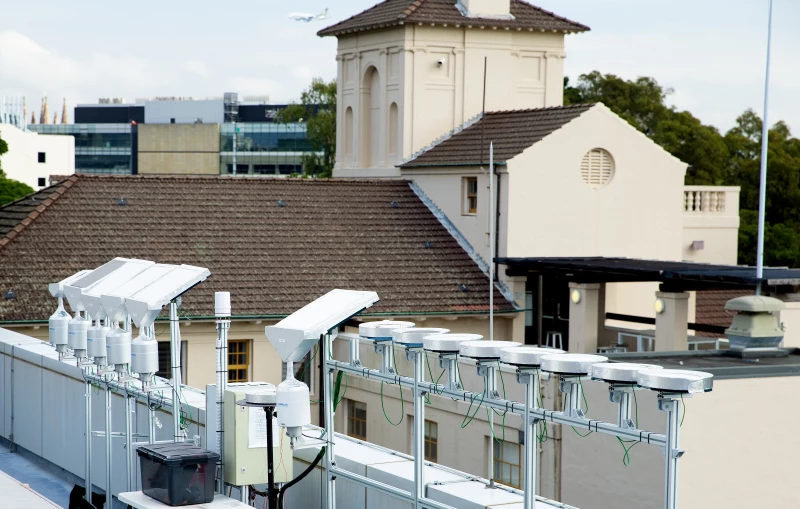
Painted tiles being tested on the roof of the Sydney Nanoscience Hub
Unlike conventional white paints that rely on titanium dioxide pigments to reflect light, this new coating gets its cooling ability from structure rather than color. It’s made from a porous fluoropolymer called PVDF-HFP, filled with microscopic air pockets that scatter sunlight in all directions. Because it doesn’t rely on UV-absorbing chemicals, the coating avoids the degradation that limits other reflective paints and maintained its performance throughout six months of harsh Australian sun.
Dr. Ming Chiu, Chief Technology Officer at Dewpoint Innovations, explained that the design offers high reflectivity without producing glare. “By removing UV-absorbing materials, we overcome the traditional limit in solar reflectivity while maintaining visual comfort. It’s more appealing for real-world use and longer-lasting in tough conditions,” he said.
The smooth topcoat also helps guide condensed water droplets toward collection points, potentially turning roofs into small-scale water farms. In humid regions, it could generate enough water for basic household needs, while in arid areas, it could support agriculture, cooling systems, or even hydrogen production.
Dewpoint Innovations is now developing a water-based version that can be applied like standard paint with rollers or sprayers. CEO Perzaan Mehta said the partnership with the university is bringing the concept to market. “It’s a scalable, energy-free solution that transforms rooftops into reliable sources of clean water,” he said.
The research, published in Advanced Functional Materials, represents a rare combination of sustainability, simplicity, and practicality. As Neto put it, “Imagine roofs that not only stay cooler but also make their own fresh water. That’s the promise of this technology.”


