

Image Courtesy: AVIO SPA
A team of US engineers has created a new composite material capable of repairing internal damage more than 1000 times, potentially extending the lifespan of critical components used in industries such as aviation automotive manufacturing and renewable energy
The material addresses a long standing issue in fiber reinforced polymers where internal layers separate in a process known as delamination This type of damage weakens structures over time and has limited the durability of lightweight composites for decades according to research published in Proceedings of the National Academy of Sciences and detailed here.
To solve this researchers introduced a 3D printed interlayer made from a thermoplastic polymer called EMAA This layer is embedded between composite sheets and acts as a built in repair system In addition to enabling healing the interlayer also improves resistance to damage making the material two to four times more resistant to delamination from the outset
The second key feature involves thin embedded heating elements within the composite When damage occurs an electrical current activates these layers heating the polymer until it melts and flows into cracks As it cools the material re bonds restoring structural integrity in a process described as thermal remending
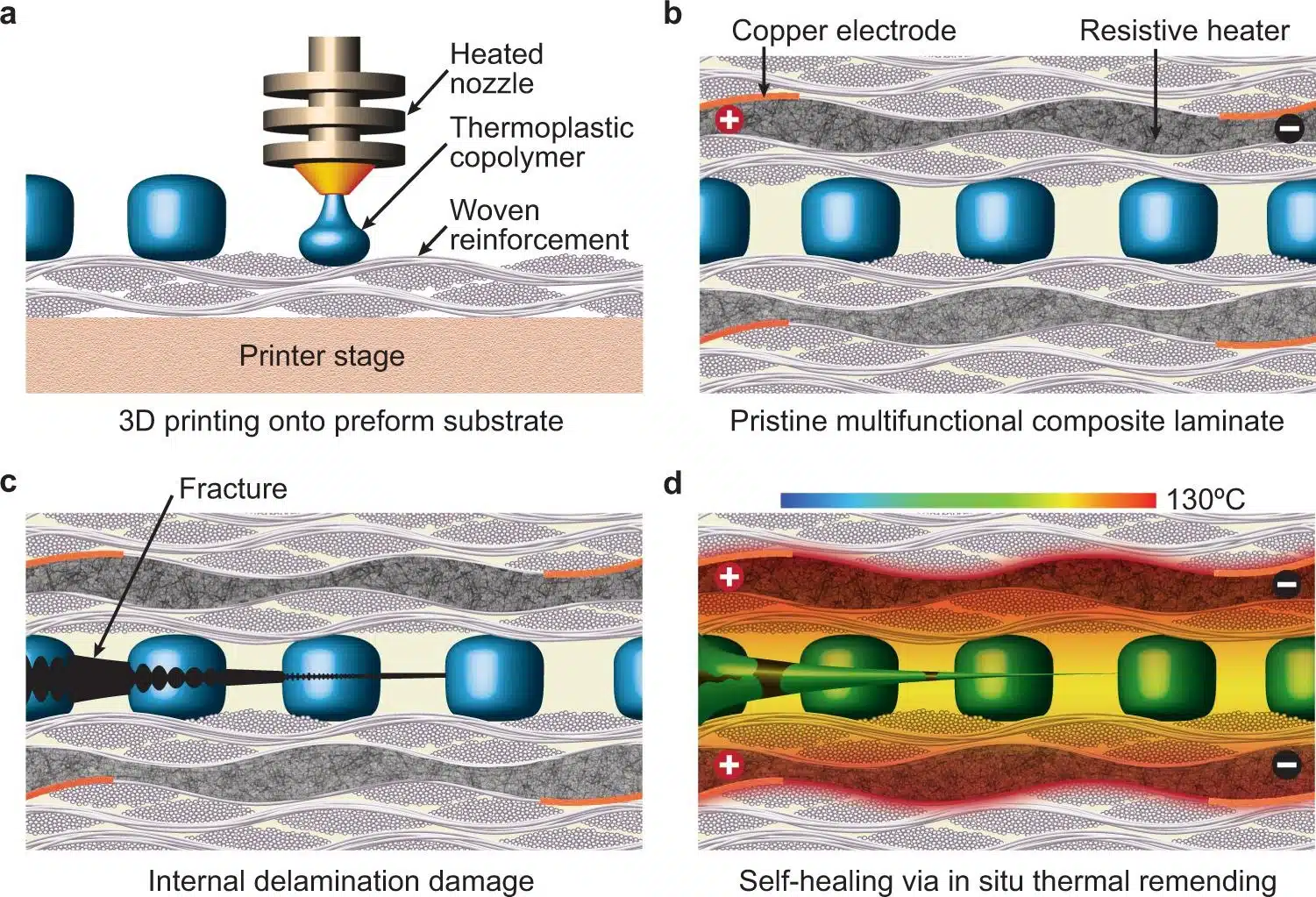
Overview concept of self-healing via in situ thermal remending. Image credit: Nature Communications
Laboratory testing showed the material could undergo 1000 cycles of damage and repair over a 40 day period While performance gradually declined the reduction in strength was minimal suggesting the material could remain functional over extended periods Researchers estimate that such composites could last more than a century with periodic repairs and potentially several centuries under optimized conditions
The development has implications for industries that rely on lightweight materials to improve efficiency In aviation and automotive sectors stronger and longer lasting composites could reduce maintenance costs and improve safety In wind energy where turbine blades are made from similar materials the technology could help extend operational life and reduce waste
Current wind turbine blades are difficult to recycle and often end up in landfills after about 20 years of use Extending their lifespan through self healing materials could delay disposal and reduce the volume of waste generated
Researchers note that further testing is needed before the material can be deployed commercially Real world conditions such as temperature changes moisture exposure and impact damage will need to be evaluated to confirm long term performance


