

For decades, the idea of personal flying machines has hovered at the edge of imagination promising a future where traffic jams are a thing of the past and daily commutes happen high above the roads. From The Jetsons to modern prototypes, that vision has felt perpetually just out of reach.
Now, a company aptly named Jetson believes it’s ready to make personal air travel a reality. Its creation, the Jetson ONE, is a sleek, lightweight electric aircraft or more precisely, an electric Vertical Take-Off and Landing (eVTOL) vehicle designed for individual pilots. Unveiled at the 2025 UP.Summit in Arkansas, Jetson’s flying machine is drawing attention not just for its futuristic looks, but for what could be the dawn of everyday personal aviation.
The Jetson ONE made headlines during the UP.Summit, an exclusive event that gathers over 300 of the world’s leading innovators in mobility. Among the highlights was the world’s first Jetson ONE race, featuring four aircraft zipping around pylons in a dazzling display of agility and control. One of the pilots was Tomasz Patan, Jetson’s co-founder and Chief Technical Officer, who helped bring this ambitious vision to life.
While the race may have looked like a scene from a science fiction movie, Jetson hopes it’s a glimpse into the future of everyday transportation, a world where personal aerial vehicles aren’t confined to exhibitions but become a viable commuting option.
Jetson describes the ONE as “a Formula One car for the sky.” And while its performance isn’t quite that of a racing jet, it does boast some impressive figures. The aircraft weighs just 121 pounds without batteries and 253 pounds fully equipped, powered by eight electric motors and propellers. It can reach a software-limited top speed of 63 mph and climb to over 1,500 feet, all while being operated one-handed through a four-axis joystick.
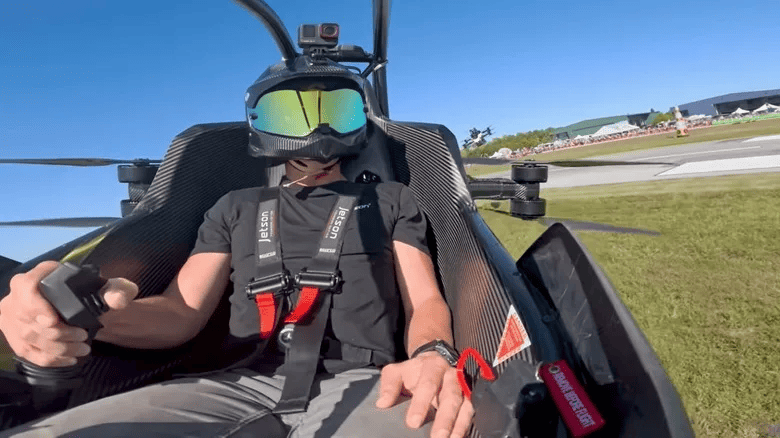
Safety is central to its design. The protective safety cell, inspired by race car engineering, is reinforced with carbon fiber and aluminum. The Jetson ONE also includes a ballistic parachute, auto-landing capability, hands-free hover mode, and the ability to continue flying even if one motor fails.
“We’ve created a personal aircraft that’s intuitive to fly. The fundamentals of flight control can be mastered in under five minutes,” says Jetson, emphasizing its accessible design.
The 20-minute flight time may not replace your car just yet, but for short hops or thrill rides, it’s a remarkable step forward. However, with a price tag of $128,000 and first deliveries scheduled for 2028, it’s clear that the Jetson ONE is currently a luxury for early adopters rather than a mass-market commuter tool.
The first customer to receive a Jetson ONE is Palmer Luckey, cofounder of Oculus and Anduril Industries, a tech visionary well-versed in futuristic systems. Luckey took delivery of his eVTOL in September 2025, two years after the original target date. Despite the company’s claim that the craft can be learned in minutes, Luckey underwent 50 minutes of training before taking off and successfully completing a test flight.
At the end of his flight, he was awarded Jetson’s symbolic “wing pin,” marking the official handover of the first Jetson ONE.
Founded in Poland in 2017 by Tomasz Patan and Peter Ternström, Jetson later moved its operations to Italy and established a U.S. base in Palo Alto, California. The company has now received over 500 orders for its futuristic aircraft. With its first delivery complete and growing interest from tech leaders, Jetson declares this milestone as “the beginning of Jetson’s global rollout and a bold leap forward in personal aviation.”


