

Image Courtesy: YouTube
If you have ever looked out of an airplane window, you may have noticed that every single one is rounded at the corners. No sharp edges, no straight lines. It is a design detail so consistent across every aircraft from every manufacturer that it barely registers as a choice. But it is a very deliberate one – and the decision to make it standard was driven by one of the most catastrophic series of accidents in aviation history.
In the early 1950s, the British de Havilland Comet became the world’s first commercial jet airliner to enter passenger service. It was a remarkable achievement, faster and more comfortable than anything that had come before it. The windows on the Comet were square, with sharp corners – a design that seemed perfectly reasonable at the time.
Between 1953 and 1954, three Comets broke apart in mid-air and crashed, killing everyone on board. The accidents were investigated exhaustively, and the findings changed aviation forever.
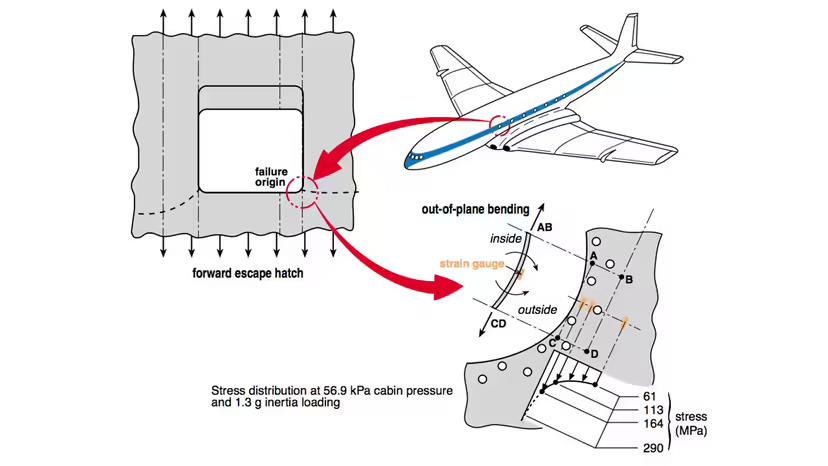
The problem was metal fatigue caused by pressurisation cycles. Every time a commercial aircraft climbs to altitude, the cabin is pressurised to keep passengers breathing comfortably. Every time it lands, the pressure releases. This expansion and contraction happens on every single flight, and over hundreds of cycles it places enormous stress on the aircraft’s structure.
The critical finding was that stress concentrates at corners. On the Comet, the square windows created four stress concentration points at each corner – areas where the repeated pressurisation cycles caused microscopic cracks to develop in the metal. Those cracks grew with each flight until the fuselage failed catastrophically at altitude.
The solution is straightforward geometry. A circular or oval shape has no corners, which means there are no points where stress can concentrate. Load is distributed evenly around the entire frame of the window, dramatically reducing the risk of fatigue cracking over thousands of pressurisation cycles.
Following the Comet disasters, rounded windows became an industry standard adopted by every commercial aircraft manufacturer. The investigation also led to sweeping changes in how aircraft are designed, tested, and certified – including mandatory fatigue testing that simulates thousands of pressurisation cycles before any new aircraft enters service.
Every rounded window on every flight you have ever taken exists because of what went wrong on the de Havilland Comet. It is one of the clearest examples in engineering history of a safety standard written in tragedy.


