

Courtesy: Gemini South Telescope
It’s not every day a comet from outside our solar system comes swinging by, and it’s definitely not every day that one starts changing colors in front of our eyes. That’s exactly what’s happening with 3I/ATLAS, the latest interstellar object that astronomers are watching closely.
When it was first spotted, 3I/ATLAS glowed with a reddish hue. But now, as it drifts closer to the Sun, it has taken on a greenish tint. Astronomers caught the shift using long-exposure images from Namibia during the recent lunar eclipse. The sight was so striking that comet specialists immediately began digging for answers.
The leading theory is that cyanide gas is being released as the comet heats up. Cyanide tends to glow green under solar radiation, and Harvard astrophysicist Avi Loeb has suggested that the change in color could be tied to a spike in cyanide emissions. At the same time, small icy grains may be scattering sunlight in new ways, adding to the shift we’re seeing.
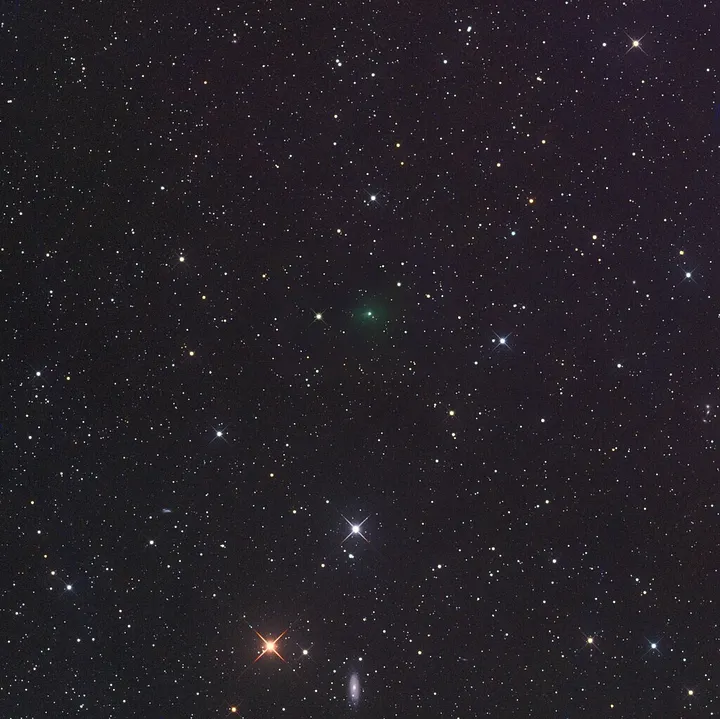
Deep imaging of the glow around 3I/ATLAS on September 7, 2025 displays a green color. (Credit: M. Jäger and Gerlad Rhemann)
Another piece of the puzzle is what this comet is made of. Early studies revealed it’s unusually rich in carbon dioxide, possibly making up nearly 90 percent of its content. That’s way higher than most comets observed in our own solar system. As the CO? escapes, it may be driving off dust and gas that change how the light reflects around the comet’s halo, or coma. That might explain why the once-red glow has transformed into a brighter green.
Of course, with any interstellar visitor, speculation runs wild. Loeb has previously stirred debate by suggesting some objects like this could be artificial, similar to the buzz around ?Oumuamua a few years back. But most experts believe 3I/ATLAS is behaving like a comet should: shedding material, changing brightness, and responding to the Sun’s heat.
What makes this object so fascinating is the chance to compare it with other outsiders like Borisov or ?Oumuamua. Those visitors gave us hints that interstellar comets might not all play by the same rules, and 3I/ATLAS could be another example of that. Watching it change colors in real time isn’t just a rare treat—it’s a glimpse into how cosmic chemistry works far beyond our neighborhood.
So is it alien tech, or just a really dramatic comet? The safe bet is the latter. But the fact that we can even ask the question makes 3I/ATLAS one of the most intriguing objects flying through the night sky right now.


