

Image Credit: Getty Images
The Apple App Store is experiencing renewed growth, with a sharp increase in new app launches suggesting a resurgence in developer activity. Recent data indicates that artificial intelligence tools may be playing a key role in accelerating this trend.
A report from Appfigures shows that global app releases rose 60 percent year over year in the first quarter of 2026 across both iOS and Android platforms. On the App Store alone, growth reached 80 percent, with April figures showing further acceleration. The increase comes amid earlier concerns that AI-powered services might reduce reliance on traditional apps, according to TechCrunch.
Instead, industry observations suggest the opposite effect. AI development tools are making it easier for individuals without formal programming experience to build and launch mobile applications. This has lowered barriers to entry, enabling a broader range of creators to participate in the app ecosystem.
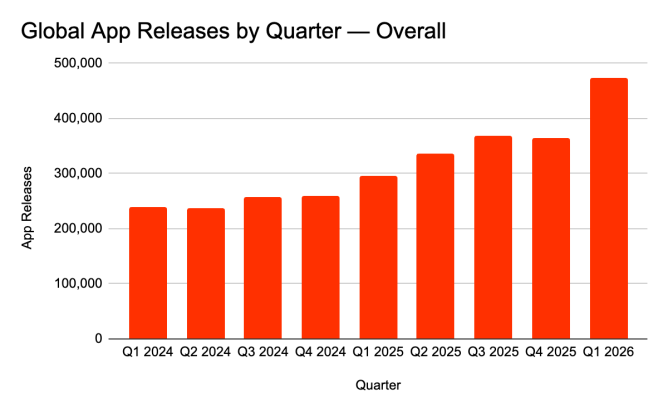
Image Courtesy: AppFigures
Greg Joswiak, Apple’s senior vice president of worldwide marketing, noted that predictions about the decline of the App Store may have been overstated. At the same time, companies such as OpenAI and figures like Jony Ive are exploring new AI-driven hardware platforms, reflecting ongoing shifts in how users interact with technology.
Data from the report highlights changes in app categories. Mobile games remain the largest segment, but productivity, utilities, and lifestyle applications have climbed in ranking. Health and fitness apps also continue to see strong activity, indicating broad-based growth rather than expansion limited to a single category.
AI-assisted development platforms, including tools like Replit, are believed to be contributing to the surge. These systems allow developers to generate code, test features, and deploy applications more quickly than traditional methods, potentially fueling what some analysts describe as a new wave of app creation.
However, the rapid increase in submissions presents challenges. Apple has faced scrutiny over app review processes after allowing certain problematic apps to gain visibility before removal. The company continues to enforce policies aimed at filtering out misleading or fraudulent applications, but higher volumes may strain oversight mechanisms.
Past data shows that Apple has rejected hundreds of thousands of apps for violations ranging from spam to deceptive practices. Analysts suggest that as AI tools enable faster development, the need for stricter monitoring and improved review systems will increase.
The current growth indicates that AI may be expanding, rather than replacing, the role of mobile apps. By simplifying development, it is reshaping how software is created and distributed, while also introducing new complexities for platform governance.


