

Credit: SciTechDaily.com
In a groundbreaking experiment, physicists have shown for the first time that even a single photon obeys one of nature’s most fundamental rules: the conservation of angular momentum.
A collaborative team led by Tampere University with researchers from Germany and India demonstrated that when a single photon splits into two, its angular momentum is preserved. The work, published in Physical Review Letters, provides direct evidence that this conservation law holds even under the most delicate conditions possible in quantum physics.
Conservation laws define what is and isn’t possible in the natural world. Much like billiard balls transferring momentum on impact, spinning objects conserve angular momentum. Light is no exception: photons can carry orbital angular momentum (OAM), tied to the spatial structure of their beam.
At the quantum scale, this means that if one photon carries angular momentum, any interaction or division it undergoes must balance that value.
The team confirmed this with a simple but powerful rule: when a photon without OAM splits into two, the result must always cancel out. If one of the new photons emerges with +1 OAM, the other must carry -1 OAM, ensuring the total remains zero.
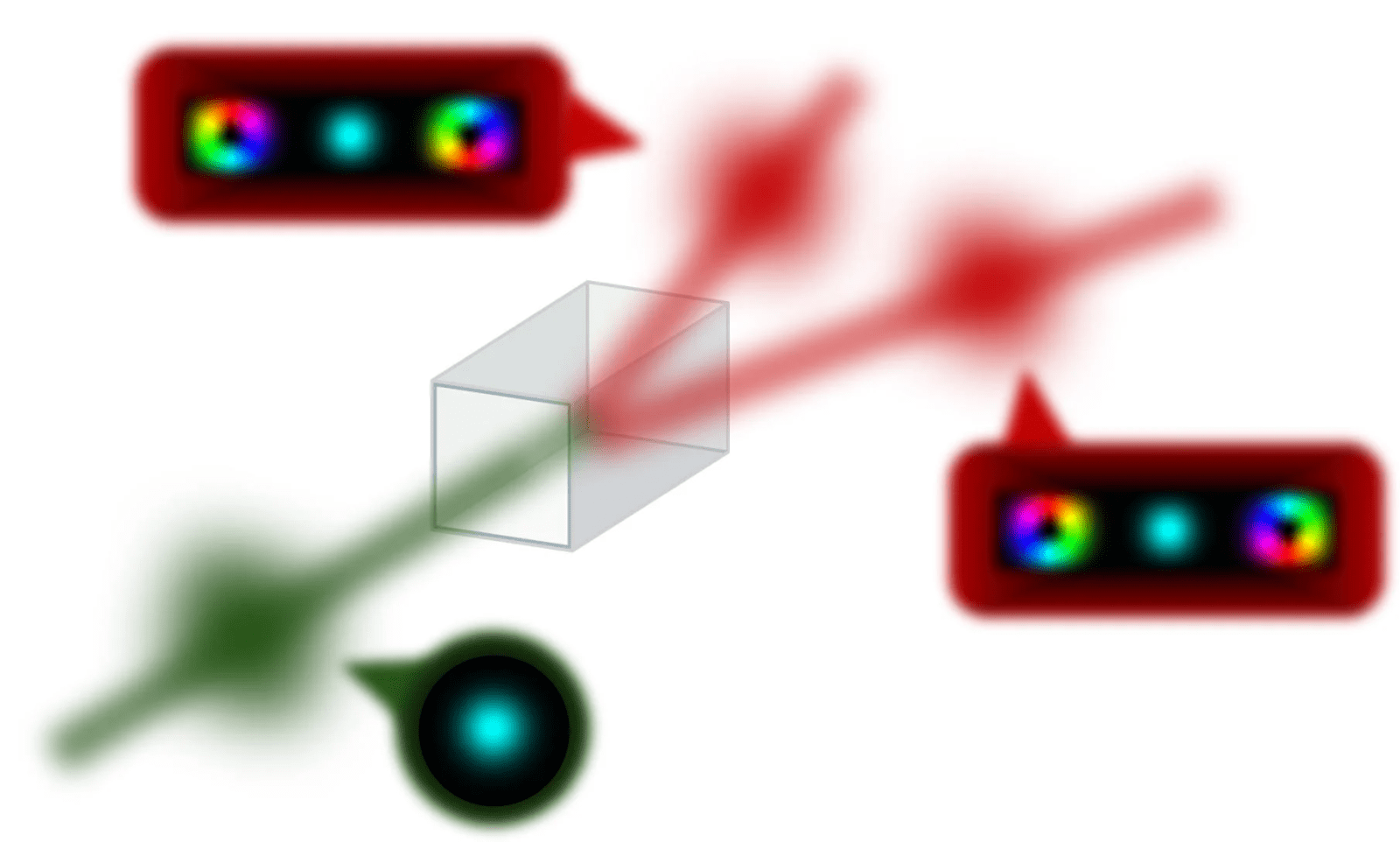
Schematic of a single photon with zero angular momentum (green) splitting into two photons (red) with either zero or opposite angular momenta (sketched through the spatially varying color), which adds up to zero confirming the fundamental angular momentum conservation law. Credit: Robert Fickler / Tampere University
“Our experiments show that the OAM is indeed conserved even when a single photon drives the process. This confirms a key conservation law at the most fundamental level, which is ultimately based on the symmetry of the process,” said Dr. Lea Kopf, lead author of the study.
Though conservation has been tested before using laser-based optics, this was the first time it was confirmed at the level of an individual photon.
The process was anything but simple. Because the nonlinear optical conversion required is extremely inefficient, only about one in a billion photons successfully split into a pair. Measuring such rare events was compared to “finding a needle in a haystack.”
Still, with a stable optical setup, ultra-low noise, and a highly efficient detection system, the team gathered enough successful events to confirm the law.
Beyond proving angular momentum conservation, the experiment offered a glimpse into the first signs of quantum entanglement within the photon pairs.
“This work is not only of fundamental importance, but it also takes us a significant step closer to generating novel quantum states, where the photons are entangled in all possible ways—space, time, and polarization,” said Prof. Robert Fickler, who leads the Experimental Quantum Optics Group at Tampere.


