

Image Courtesy: Scottish Power
Archaeologists have uncovered a remarkably well-preserved anchor believed to be nearly 2,000 years old beneath the seabed of the North Sea. The find offers rare physical evidence of ancient maritime activity in northern European waters.
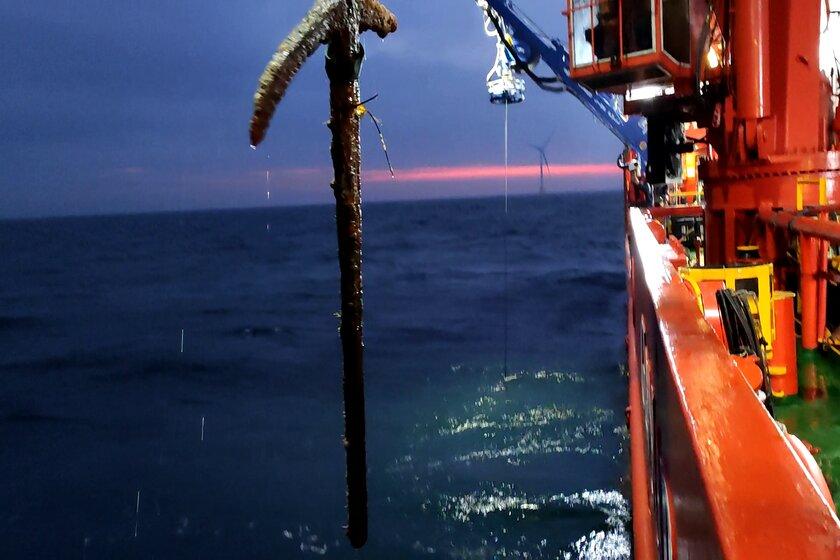
The anchor, discovered off the coast of the United Kingdom during a seabed survey, had remained buried under layers of sand for centuries. Its preservation is unusual given that it is made of both wood and iron, materials that typically degrade quickly in marine environments, according to a report by Arkeonews.
Experts believe the surrounding sediment played a crucial role in protecting the object. Low oxygen conditions beneath the sand likely slowed the natural decay process, allowing the structure to remain largely intact. Maritime archaeologist Brandon Mason noted that anchors from this period rarely survive in such condition, particularly outside the Mediterranean region.
Preliminary analysis suggests the anchor dates back to the Roman era. If confirmed, it would be among only a small number of pre-Viking anchors ever found in northern Europe. The design combines a wooden framework with iron components for weight and stability, reflecting practical engineering methods used in ancient shipbuilding.
The discovery also provides insight into historical trade routes. Archaeologists believe the anchor once belonged to a vessel engaged in regional commerce, possibly transporting goods such as metals and pottery across the North Sea. The find supports evidence that these waters were actively used for trade long before modern shipping networks developed.
The object was initially detected using sonar scanning technology, which can identify buried structures beneath the seabed. Researchers say advances in mapping and survey techniques are enabling more detailed exploration of underwater environments, revealing artifacts that were previously undetectable.
Further study of the anchor is expected to provide additional information about its construction, usage, and origin. Researchers aim to better understand the scale of maritime activity in the region during the Roman period.
The find highlights the potential for future discoveries beneath the ocean floor, where large areas remain largely unexplored. Archaeologists say such artifacts can help fill gaps in historical records and offer direct insight into ancient trade and navigation.


