

A 370-million-year-old fossil discovered in Scotland has been confirmed as an entirely new and now-extinct form of complex life, according to new research published in Science Advances. The organism, known as Prototaxites, stood up to 26 feet tall and dominated Earth’s earliest land ecosystems, yet fits into neither the plant nor fungal branches of the tree of life.
Long mistaken for a giant fungus or a primitive tree trunk, Prototaxites has puzzled scientists since it was first collected in 1843. It resembled a massive, leafless column, more like a petrified pillar than any modern organism. Earlier theories proposed it was a rotting conifer, a lichen, or an outsized fungus, but none fully explained how it grew so large or sustained itself.
New analysis by researchers from the University of Edinburgh and National Museums Scotland examined fossils preserved in the Rhynie chert formation in Aberdeenshire. By studying both the anatomy and molecular chemistry of the specimens, the team found that Prototaxites lacks the defining traits of fungi, plants, or any other known large lifeform. Its internal structure and chemical signatures were fundamentally different from organisms living at the same time, as reported by the Scientific American.
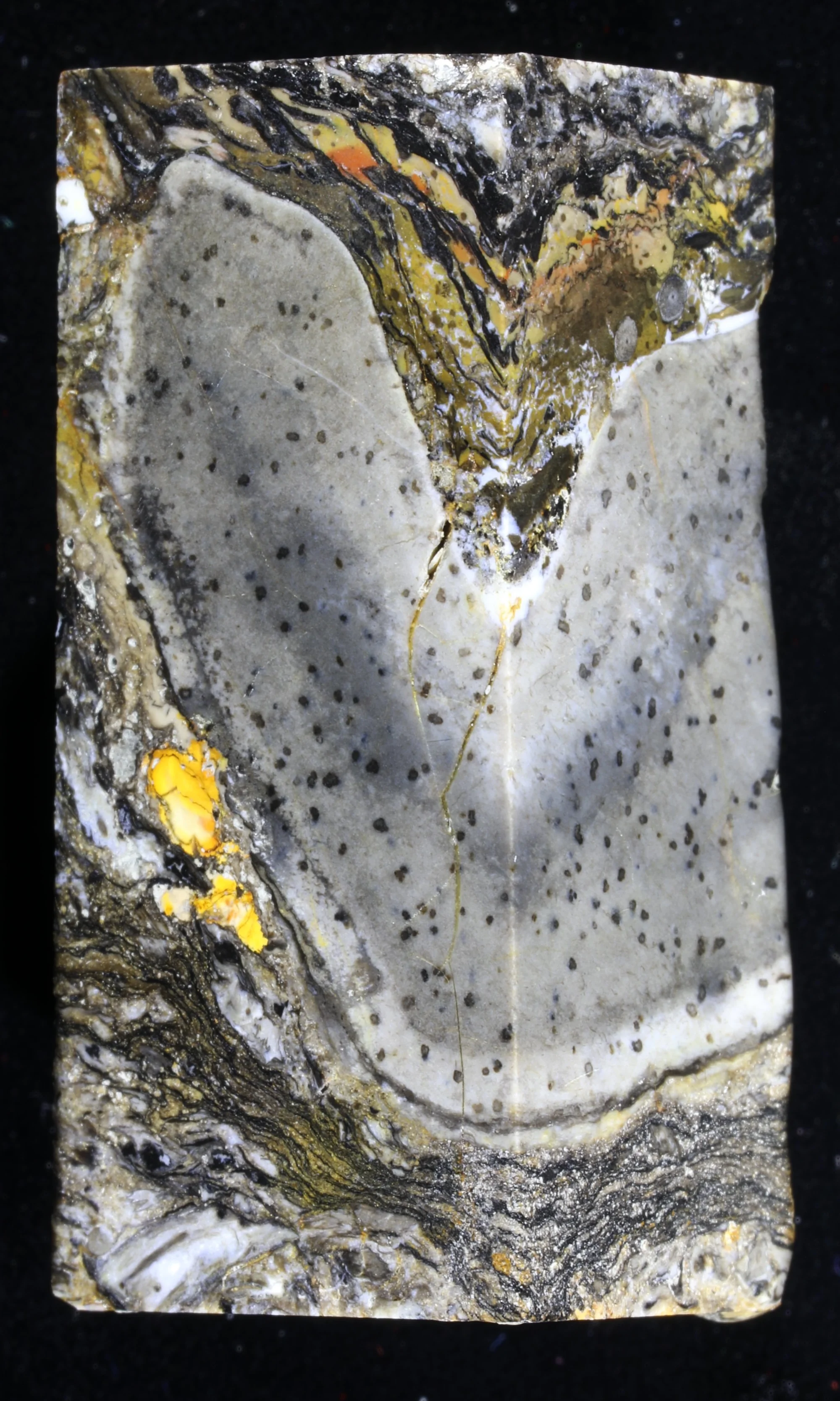
A fossil specimen of Prototaxites taiti shows its spotty internal structure. Laura Cooper, University of Edinburgh
Sandy Hetherington, a research associate at National Museums Scotland and lead co-author of the study, said the fossils represent “life, but not as we now know it,” explaining that Prototaxites belongs to an entirely extinct evolutionary lineage. The findings suggest it was a unique experiment in complex life, one that emerged independently and disappeared without leaving modern descendants.
The organism lived between roughly 420 and 370 million years ago, spanning the late Silurian to late Devonian periods. This was a pivotal era when life was just beginning to colonize land. At that time, plants were small and animals barely venturing out of water. Prototaxites towered over everything else, making it the first known giant organism to inhabit Earth’s surface.
Unlike plants, it did not rely solely on photosynthesis. Unlike fungi, it lacked the vast underground mycelial networks needed to gather enough nutrients. These contradictions had kept its identity unresolved for more than a century. The new research concludes that Prototaxites represents a branch of complex eukaryotic life that rose, dominated early landscapes, and then vanished entirely.
Laura Cooper, a doctoral researcher at the University of Edinburgh and co-author of the study, described Prototaxites as an “independent experiment” in building large, complex organisms. Without exceptionally preserved fossils, she noted, humanity would never have known such a form of life existed.
The discovery reshapes how scientists think about early evolution on land. It shows that life once explored far more radical paths than those that survived to the present day, and that Earth’s deep past hosted giants that do not fit into any modern biological category.


