

In the drone saturated battlefields of Ukraine, evacuating wounded soldiers has become one of the most dangerous tasks in modern warfare. With constant aerial surveillance and attack drones overhead, sending another human to rescue the injured can be a fatal gamble. To reduce that risk, Ukrainian forces are increasingly using ground robots to extract wounded troops from the front lines, as reported by Business Insider.
These machines, known as uncrewed ground vehicles, are being deployed as remote controlled stretchers. They crawl or roll into areas too exposed for medics, load injured soldiers, and pull them back to safer positions. A US Navy veteran currently in Ukraine told Business Insider that while the robots are far from perfect, they are often the only viable option when every movement is visible from the air.
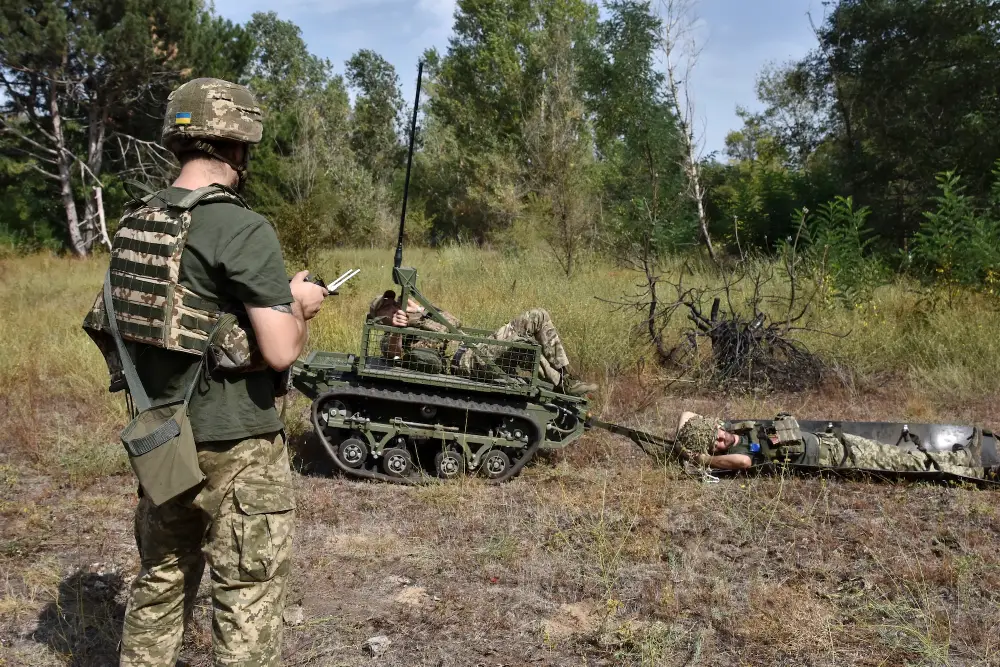
Courtesy: AP Photo/Andriy Andriyenko
Ukraine has embraced a pragmatic approach. Rather than building expensive, highly complex systems, many of the evacuation robots are intentionally simple and relatively cheap. The logic is brutal but clear. On a battlefield where drones can destroy equipment in minutes, it is better to lose a ten thousand dollar robot than a trained medic or a wounded soldier left behind.
The same ground robots are also used for other tasks, including hauling supplies, laying mines, and carrying explosives. Even so, evacuation remains one of their most emotionally charged roles. Ukrainian soldiers describe them as a last resort, a final chance when no human can safely reach the wounded. Jamming, mechanical failures, and direct attacks are constant risks, and sometimes the robot never makes it back.
Western militaries are watching closely. For decades, NATO forces relied on air superiority and helicopter evacuations to preserve the so called golden hour after injury. Ukraine’s experience shows that in a high intensity war against a peer adversary, that assumption may collapse. Without control of the skies, casualty evacuation becomes slower, riskier, and far deadlier.
The lesson many draw from Ukraine is not about advanced robotics or artificial intelligence. It is about scale, cost, and speed. Simple machines that can be built quickly, replaced easily, and accepted as expendable may save more lives than a handful of exquisite platforms that are too expensive to lose.
As one veteran put it, these robots do not need to be elegant. They just need to work well enough to give a wounded soldier hope, and sometimes, that is the difference between life and death.


