

‘Swamped Skies’ by Joshua Rozells
SpaceX has crossed a major milestone by launching its 10,000th satellite into low Earth orbit, marking a significant expansion of its space based internet infrastructure. The growing number of satellites is now becoming visible from the ground, with new images highlighting how orbital density is affecting the appearance of the night sky.
The impact has been documented by astrophotographer Joshua Rozells, who created a composite image showing satellite streaks across the sky. His work illustrates how frequently satellites now pass through observational frames, particularly in the hours after sunset, according to PetaPixel.
Rozells’ image, built from 343 individual exposures taken over roughly 85 minutes, shows numerous bright streaks caused by sunlight reflecting off satellites in orbit. These streaks are most visible during twilight periods, when satellites remain illuminated while the ground is in darkness.
Low Earth orbit satellites typically operate at altitudes between 300 and 1,200 kilometers. At these heights, objects travel at speeds exceeding 7 kilometers per second, completing an orbit in roughly 90 minutes. As the number of satellites increases, the probability of multiple objects crossing a camera’s field of view rises significantly.
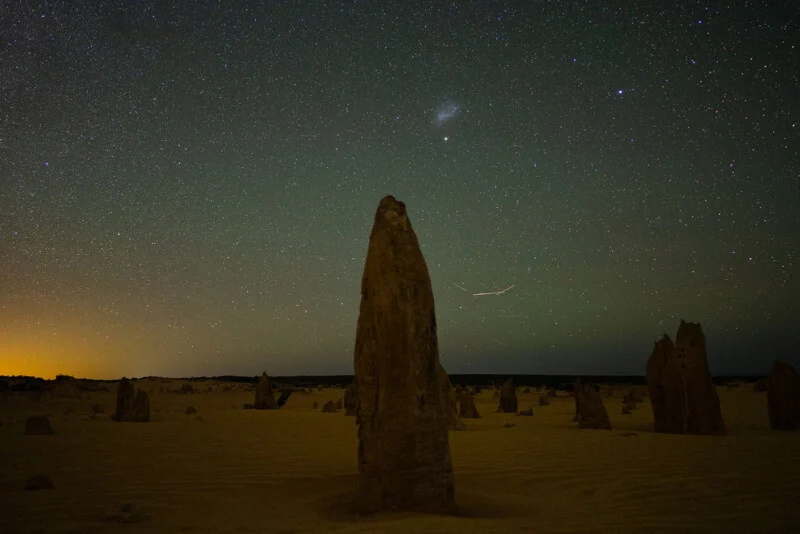
A single frame that’s contained within the composite.
From an engineering perspective, large satellite constellations are designed to provide continuous global coverage. Systems such as Starlink rely on thousands of interconnected satellites to deliver low latency internet by maintaining line of sight communication with ground stations and user terminals.
This architecture requires dense orbital deployment, with satellites arranged in multiple planes to ensure uninterrupted service. However, this density also increases optical interference, particularly for long exposure imaging and astronomical observations.
Satellite streaks can interfere with telescope data by introducing noise and obscuring faint celestial objects. For optical astronomy, even brief streaks can disrupt observations, requiring additional processing or repeated imaging to obtain usable data.
The issue is compounded by the reflective properties of satellite surfaces. Engineers have introduced mitigation strategies, including darker coatings and orientation adjustments, to reduce reflectivity. However, the effectiveness of these measures varies depending on viewing angle and orbital position.
Rozells noted that earlier in his work, satellite streaks appeared only occasionally, but now occur in nearly every frame captured during certain time windows. His composite image required extensive post processing to isolate and combine individual streaks while maintaining consistent sky coloration.
Beyond astronomy, the phenomenon highlights broader system level trade offs. Satellite constellations enable connectivity in remote regions where terrestrial infrastructure is limited, but they also introduce new constraints for observational science and night sky visibility.
As orbital deployments continue to increase, engineers and regulators are examining methods to balance communication infrastructure needs with environmental and observational considerations. Proposed approaches include improved satellite design, coordinated orbital management, and operational guidelines to reduce visual impact.
The milestone reflects both the rapid scaling of space based networks and the emerging need to address their unintended effects on Earth based observation systems.


