

DF-17 medium-range hypersonic ballistic missiles of the hypersonic missile formation attend V-Day military parade.
A leaked Pentagon assessment is offering a sobering look at how China could threaten even the US Navy’s most advanced aircraft carrier strike groups. The internal study, known as the “Overmatch Brief,” uses computer simulations to outline how the People’s Liberation Army could neutralize or even sink America’s newest aircraft carriers in a future conflict, as reported by Military Watch Magazine.
According to the simulations, China would not rely on a single dramatic weapon or attack. Instead, the study concludes that the PLA would employ a layered and coordinated campaign designed to overwhelm US defenses from multiple directions at once. This would include long-range missile strikes, cyber operations, and attacks on US space assets that underpin modern naval warfare.
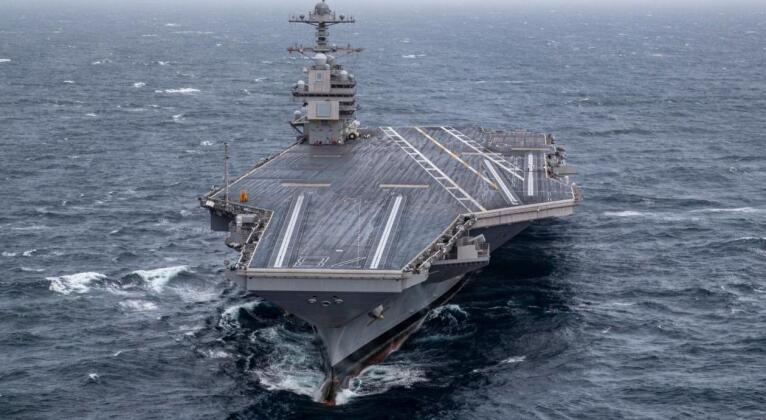
U.S. Navy Supercarrier USS Gerald Ford
A key finding of the assessment is the central role of cyber and anti-satellite operations. In the simulated scenarios, Chinese attacks on US satellites used for communication, navigation, and surveillance sharply degraded American forces’ ability to operate at sea. Without reliable space-based support, carrier strike groups struggled with targeting, coordination, and flight operations, leaving them far more exposed to follow-on missile attacks.
The brief places particular emphasis on China’s growing arsenal of anti-ship weapons, including ballistic and hypersonic missiles designed specifically to target large surface vessels. These include the DF-21D and DF-26 land-based anti-ship ballistic missiles, the YJ-21 missile deployed on Chinese destroyers and submarines, and additional variants carried by H-6 bombers. Together, they form a layered strike capability that can reach far beyond China’s coastline.
Rather than firing a handful of expensive weapons, the study suggests China would use a mix of missile types. Lower-cost anti-ship missiles could be launched in large numbers to saturate and exhaust US missile defenses. More advanced hypersonic systems would then be used to penetrate those defenses and deliver decisive hits. Analysts estimate China may now possess up to 600 hypersonic missiles, many capable of traveling at more than five times the speed of sound while maneuvering in flight, making them extremely difficult to intercept.
Simulations show Chinese forces coordinating these strikes using data from satellites, over-the-horizon radars, and unmanned aircraft. The result would be overlapping engagement zones around a carrier strike group, significantly increasing the likelihood that US ships would be disabled before completing their missions.
The Overmatch Brief also highlights broader vulnerabilities in US force design. High-value platforms like aircraft carriers, fifth-generation fighters, and large satellites are increasingly threatened by cheaper systems that China can produce in large numbers. Once a few critical nodes are damaged, the effectiveness of the entire force can rapidly collapse.
Gerald R. Ford-class carriers are described as especially critical targets. Each ship costs an estimated $12.8 billion, and the Navy plans to build ten of them. The loss of even one would dramatically reduce US naval airpower, making these carriers a top priority in any major conflict.
While the Pentagon has not commented on the leaked assessment, its conclusions echo growing concern within US defense circles. As China continues to expand its hypersonic and missile capabilities, the balance of power in the Pacific may be shifting faster than previously expected.


