

Image Courtesy: Shutterstock
Decades-old space debris left floating in low Earth orbit has helped scientists uncover a previously undetected way the Sun influences objects circling Earth. Researchers found that once solar activity reaches a certain intensity, atmospheric drag increases sharply enough to accelerate the orbital decay of satellites and debris.
The study, published in Frontiers journal Frontiers in Astronomy and Space Sciences, analyzed 17 debris objects orbiting between 600 and 800 kilometers above Earth over a 36-year period spanning multiple solar cycles. Scientists discovered what they describe as a “transition boundary,” where orbital decay speeds up noticeably once solar activity exceeds roughly two-thirds of its peak intensity, according to the study.
The finding highlights how deeply connected Earth’s orbital environment is to the Sun’s 11-year activity cycle. During periods of heightened solar activity, emissions such as ultraviolet radiation and charged particles intensify, heating the thermosphere, the upper layer of Earth’s atmosphere. As that layer expands outward, atmospheric density increases at altitudes where many satellites and debris objects operate.
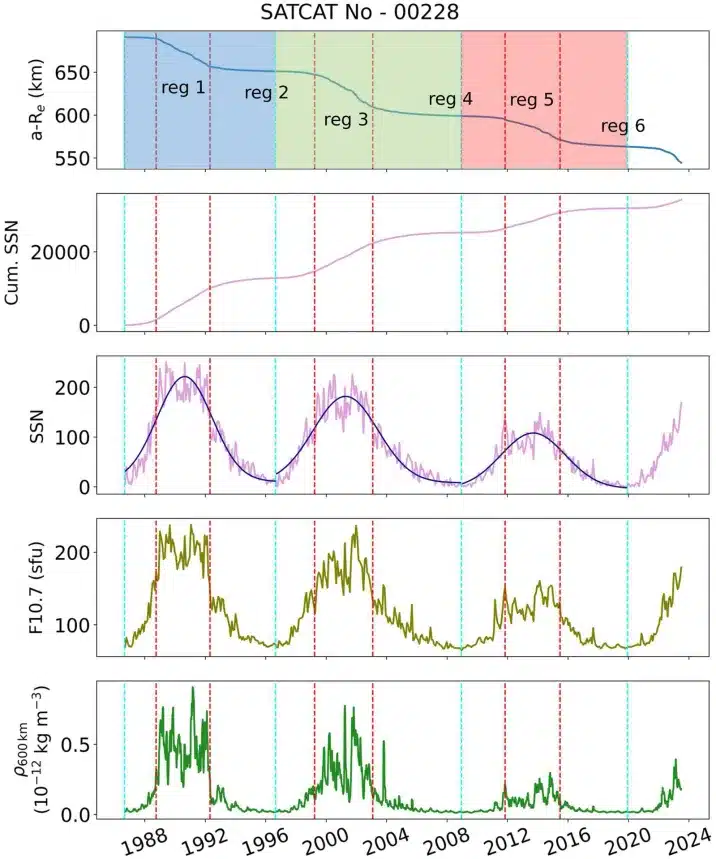
Orbital decay of space debris tracked alongside solar activity and atmospheric density changes from 1988 to 2024. Credit: Frontiers in Astronomy and Space Sciences
That denser atmosphere creates stronger drag forces, gradually slowing orbiting objects and pulling them closer to Earth. While scientists have long known solar activity affects atmospheric drag, the new study suggests the effect becomes significantly stronger after solar activity crosses a specific threshold.
Researchers tracked debris dating back to the 1960s and 1970s, including remnants of old launches and inactive spacecraft that no longer use propulsion systems to maintain altitude. Because these objects drift naturally without corrective maneuvers, they offered scientists a clearer way to isolate the effects of solar activity on orbital decay.
The timing is especially important as low Earth orbit becomes increasingly crowded. The region currently hosts thousands of active satellites, including internet constellations like SpaceX’s Starlink network, alongside millions of fragments of debris traveling at speeds fast enough to damage operational spacecraft.
The study also examined the recent solar maximum reached in 2024, a period marked by elevated sunspot activity and stronger solar emissions. Researchers linked that activity to measurable increases in atmospheric drag affecting orbiting objects.
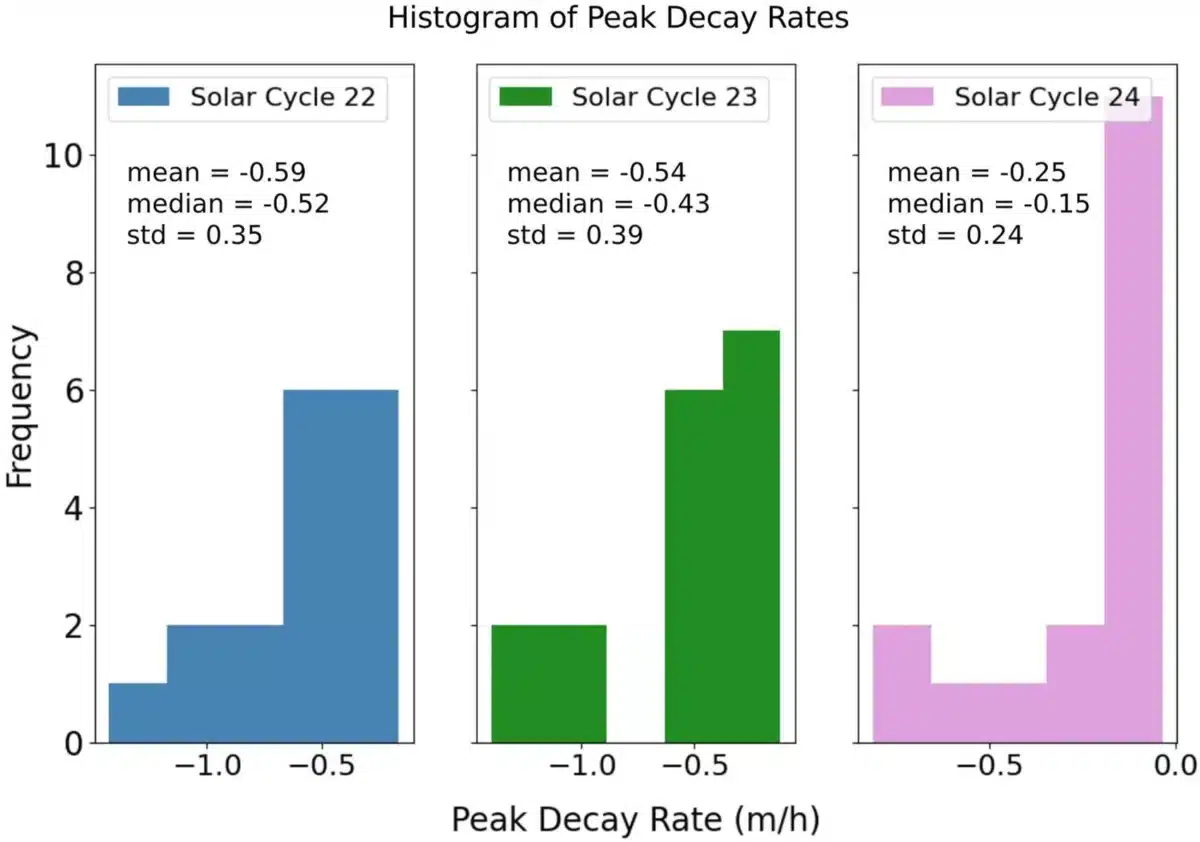
Histogram comparing peak orbital decay rates of space debris across solar cycles 22, 23, and 24. Credit: Frontiers in Astronomy and Space Sciences
For satellite operators, the implications are practical as well as scientific. Stronger drag during active solar periods can force satellites to perform more frequent orbit corrections, increasing fuel consumption and potentially shortening mission lifespans. Future missions launched near solar maximum periods may need additional fuel reserves to compensate for the effect.
The findings could also improve long-term space traffic management models as governments and private companies race to deploy larger constellations into low Earth orbit. Better predictions of orbital decay may help reduce collision risks and improve debris mitigation strategies in an increasingly congested space environment.


