

NASA’s Europa Clipper spacecraft has captured a striking new image of Uranus from an astonishing distance of about 2 billion miles, marking a major milestone as the probe continues its long journey toward Jupiter. The photo, released by NASA, shows Uranus as a faint, bright dot embedded in a star-filled background. Although the image is simple, its significance is enormous: it confirms the spacecraft’s navigation cameras are performing exactly as designed during deep space operations.
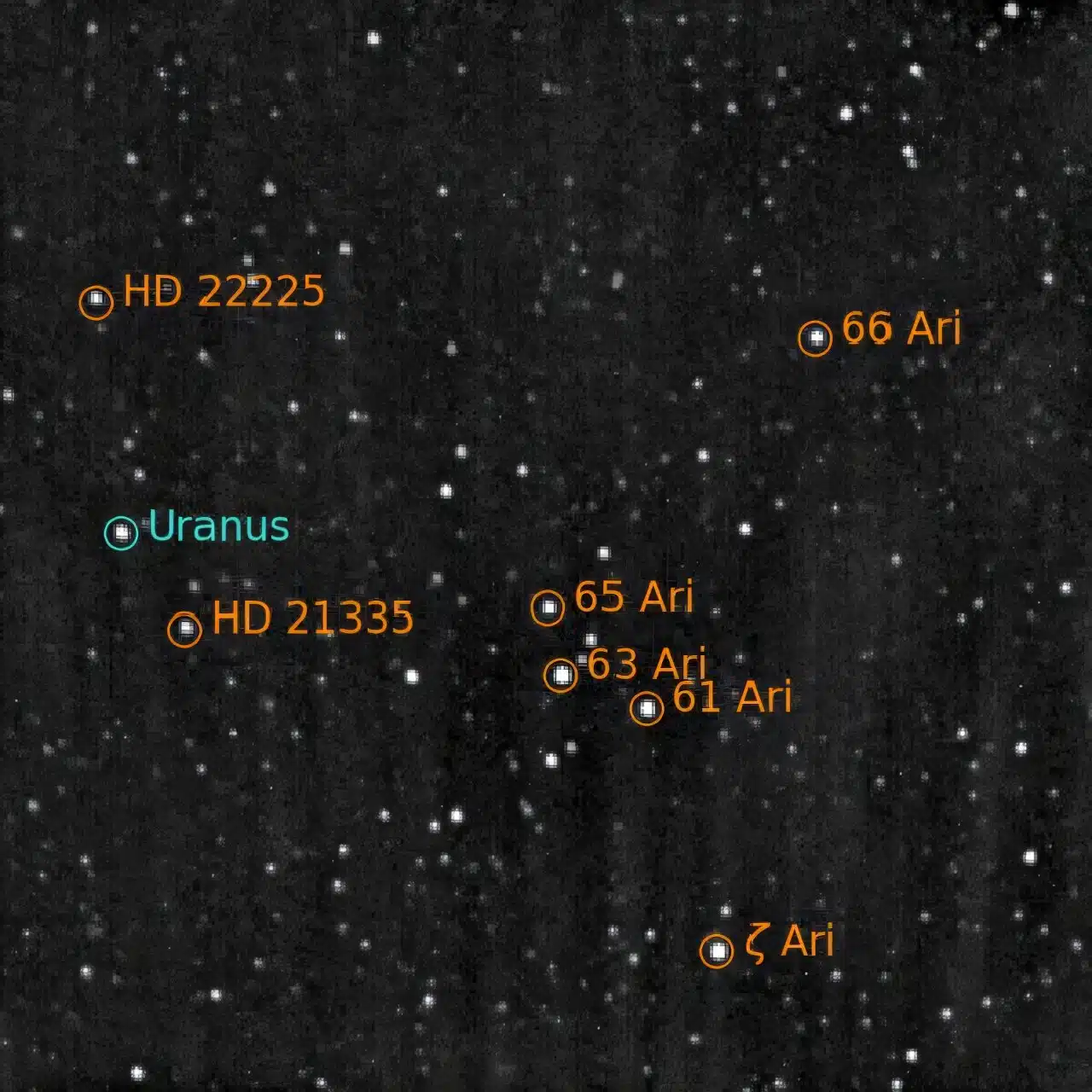
An annotated version of the image, with labels identifying Uranus and several background stars. Credit: NASA/JPL-Caltech
Europa Clipper, launched in October 2024, is currently on a multiyear cruise toward Jupiter, where it will begin more than 50 close flybys of the icy moon Europa starting in 2030. The mission aims to determine whether Europa’s subsurface ocean, hidden under a frozen crust, could support life. According to NASA, the spacecraft’s three major science goals include measuring the thickness of the ice shell, studying the exchange of materials between the surface and ocean, and analyzing the moon’s geology and chemistry.
The newly released image was taken during a test of the spacecraft’s star-tracking cameras, which are essential for precise navigation. These stellar reference units lock onto known stars to keep the spacecraft correctly oriented as it travels through the void. As reported by the U.S. space agency, each camera sees only 0.1 percent of the sky at any moment, yet can identify star patterns with remarkable precision. Capturing Uranus within this tiny field of view demonstrates the cameras’ accuracy and stability.
NASA also released an annotated version of the image and a short animation created from two exposures taken ten hours apart. The GIF shows Uranus shifting slightly against the star background, a subtle but clear movement that confirms the spacecraft’s tracking systems are functioning exactly as intended.
Accurate orientation is critical during Europa Clipper’s cruise phase. Over the coming years, the spacecraft will rely heavily on these star-tracking systems to maintain its trajectory toward Jupiter, perform course corrections, and aim instruments during scientific operations. With Earth now far behind, onboard navigation systems represent the spacecraft’s “eyes” in deep space.
As NASA notes, the mission’s exploration of Europa will offer unprecedented insight into the astrobiological potential of icy ocean worlds. The successful capture of this distant view of Uranus is a small preview of the precision and stability the spacecraft will need when it begins its close-range investigations of one of the most promising locations for life beyond Earth.


