

Stock Image
NASA has transformed a retired commercial airliner into its most advanced airborne research platform, significantly expanding its ability to study Earth’s atmosphere. The modified aircraft, a former Boeing 777, is now capable of carrying large teams of scientists and advanced instruments on long duration missions.
The aircraft replaces NASA’s aging DC-8 research platform and introduces major upgrades in range, payload, and onboard collaboration. The project is part of the agency’s broader effort to improve climate and atmospheric data collection, according to an official post by NASA.
Extensive engineering work was required to convert the aircraft into a scientific platform. The fuselage was modified to include enlarged observation windows and specialized openings beneath the aircraft, allowing instruments such as lidar and infrared sensors to capture unobstructed data. Internal systems were also redesigned to support high powered scientific equipment.
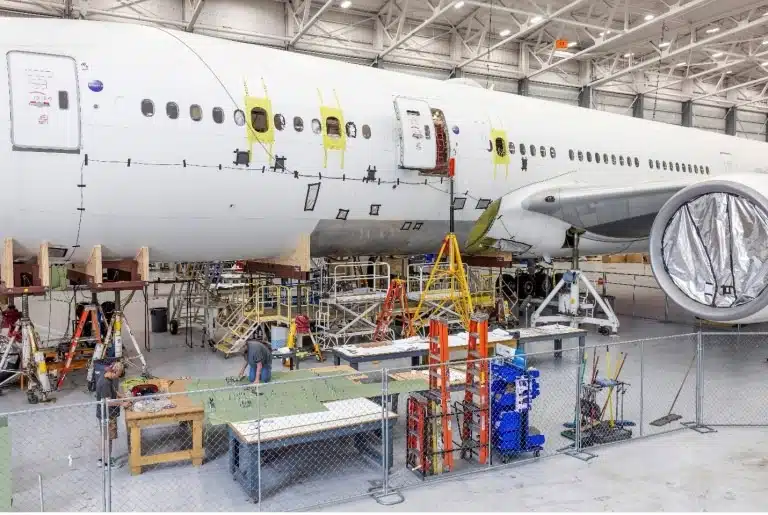
Image Courtesy: L3Harris
These structural changes were carried out with support from L3Harris Technologies, which helped adapt the aircraft while maintaining its structural integrity. The result is a hybrid system that combines long haul aviation capabilities with specialized research functions.
The upgraded aircraft can remain airborne for up to 18 hours and reach altitudes of around 43,000 feet. It also has a range of approximately 9,000 nautical miles, enabling missions over remote regions such as the Arctic without refueling. With a payload capacity of about 34 metric tons, it can carry a wide array of scientific instruments.
One of the most notable features is its capacity to host up to 100 people onboard. This allows scientists to work collaboratively during flight, analyzing data in real time and adjusting experiments as needed rather than waiting until after landing.
The aircraft’s first planned mission, known as NURTURE, will focus on studying atmospheric phenomena linked to severe winter weather. Researchers aim to track polar vortex structures that can contribute to large scale icing events and disruptions to infrastructure.
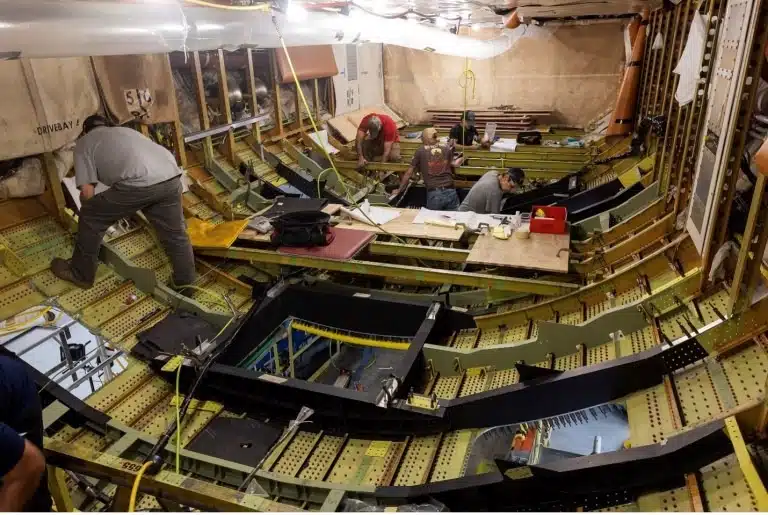
Image Courtesy: L3Harris
By enabling longer missions, larger teams, and more advanced instrumentation, the converted Boeing 777 represents a shift in how airborne science is conducted. It allows for continuous, high resolution data collection across vast areas of the planet.
The platform is expected to play a key role in future research efforts, particularly in understanding climate systems and improving weather prediction models.


