

A mouse-sized robot designed to crawl through the tightest sections of the world’s most powerful particle accelerator is changing how one of humanity’s most complex scientific machines is maintained. Engineers have created the miniature device to inspect areas inside the Large Hadron Collider that are far too small, cold, and hazardous for humans to access, offering a safer and more efficient way to monitor critical infrastructure.
The robot was developed through a collaboration between the UK Atomic Energy Authority and CERN, the European physics laboratory that operates the collider on the French-Swiss border. Built to move autonomously through narrow beam pipes stretching across the facility, the device represents a major step forward in robotic inspection technology for extreme environments, as reported by the BBC.
Measuring just 3.7 centimeters wide and about 20 centimeters long, the robot is small enough to navigate the collider’s intricate internal pipework. The Large Hadron Collider spans 27 kilometers in a circular tunnel buried around 100 meters underground near Geneva, making physical inspection a daunting challenge. More than 1,200 massive dipole magnets guide particle beams around the ring, while vacuum sealed beamlines and ultra low temperatures create conditions that are both inaccessible and potentially dangerous for human workers.
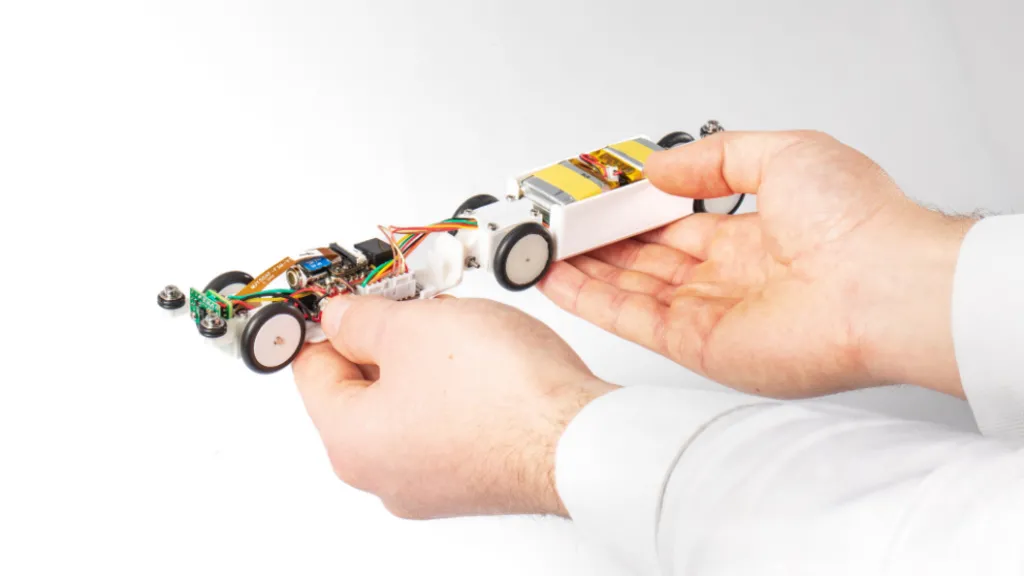
Courtesy: UKAEA
Temperatures inside parts of the collider drop to minus 271 degrees Celsius, close to absolute zero. These extreme conditions are essential for the superconducting magnets that steer particles moving at nearly the speed of light. However, they also make routine maintenance highly complex. Any faults or structural deformities in the beam pipes could disrupt experiments or cause costly downtime, increasing the need for reliable inspection methods.
The robot, named PipeINEER, was designed specifically to handle these challenges. Its name blends the words pipe and pioneer, reflecting its ability to explore areas never before reachable with such precision. As it travels through the beamline, the device captures high resolution images of internal surfaces and uses artificial intelligence systems to identify cracks, misalignments, or other defects that may require attention.
Engineers say this automation significantly reduces the need for risky manual inspections while allowing more frequent monitoring of critical components. The UK Atomic Energy Authority contributed its experience in robotics used in hazardous and hard to reach industrial settings, adapting those technologies for CERN’s specialized scientific infrastructure.
Scientists at CERN believe the robot will transform maintenance operations at the collider, helping ensure experiments run smoothly without unexpected interruptions. The facility has been central to some of the most important discoveries in modern physics, including the confirmation of the Higgs boson in 2012. Keeping its systems in optimal condition is vital for future research into fundamental particles and unexplored physical phenomena.
The innovation has already received industry recognition, earning a Highly Commended distinction at a major engineering awards program that celebrates collaborative technological breakthroughs. Project leaders say the recognition highlights the importance of international partnerships in advancing both scientific research and applied engineering.
With robotics, artificial intelligence, and advanced imaging now working together inside one of the world’s most sophisticated scientific instruments, maintaining the collider may soon become faster, safer, and far more precise than ever before.


