

Imagine stepping aboard a spacecraft knowing you and your children’s children would never return to Earth. That is the premise of Chrysalis, a conceptual generational starship designed to carry humans on a 400-year voyage to Proxima Centauri b, a potentially habitable planet in the Alpha Centauri system. The project recently won first place in the Project Hyperion Design Competition, which invited teams to outline feasible interstellar vessels using technologies that could plausibly be developed in the future.
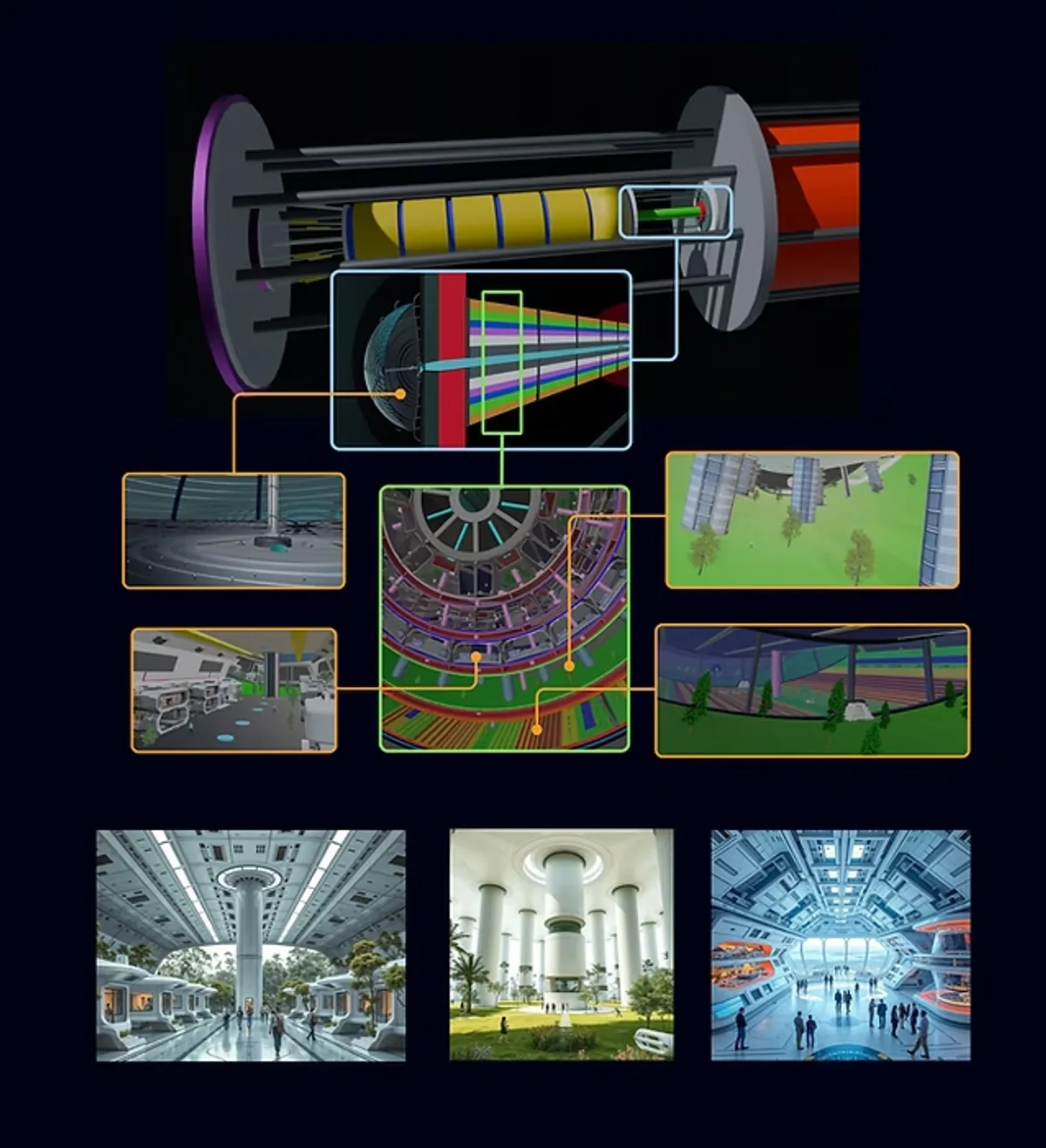
Image Credits: Project Hyperion
The ship would be staggering in scale, measuring about 36 miles long. Engineers envision it as a set of concentric cylinders, each layer dedicated to a different function. At the core would be food systems such as farmland, forests, and seed banks. Surrounding those would be spaces for housing, schools, parks, medical centers, and cultural hubs like libraries. Further outward, areas would be reserved for recycling, manufacturing, and industrial support. The outermost shell would house storage and essential life-support infrastructure, creating a kind of layered city drifting through space as described in Discover Magazine.
To keep life comfortable, the ship would rotate, producing artificial gravity. Propulsion would rely on nuclear fusion, a technology still in development but considered one of the most promising paths for deep-space travel. Construction of such a vessel could take two to three decades and might occur at a stable Lagrange point near Earth, allowing assembly without the complications of planetary gravity. Preparation for the voyage would be equally demanding, with the first generation of crew expected to undergo isolation training, potentially in Antarctic bases, to simulate the psychological strain of living in a sealed habitat for life.
The social structure on board would also break from tradition. Instead of rigid hierarchies, designers propose a sociocracy model, where collective decision-making guides governance. Artificial intelligence would support this process, maintaining continuity across centuries and providing checks against human bias.
Although the idea of a generation ship has long fascinated science fiction writers, Chrysalis stands out for treating it as a serious engineering problem. It asks not only how to move thousands of people across interstellar space but also how to sustain ecosystems, preserve culture, and maintain social stability across multiple lifetimes.
Even if Chrysalis never launches, it serves as a thought experiment with practical value. Designing for a self-contained, long-term environment mirrors challenges we face on Earth, from closed-loop agriculture to resilient infrastructure. In this way, the concept helps bridge space exploration with human survival, offering insights that could shape both future starships and sustainable life on our own planet.


