

A recent Gemini Observatory image of comet 3I/ATLAS (background) overlaid with the new Two-meter Twin Telescope image of the comet’s jet (inset). (Image credit: Comet photograph: International Gemini Observatory/NOIRLab/NSF/AURA/Shadow the ScientistImage Processing: J. Miller & M. Rodriguez (International Gemini Observatory/NSF NOIRLab), T.A. Rector (University of Alaska Anchorage/NSF NOIRLab), M. Zamani (NSF NOIRLab); Inset: Teide Observatory, M. Serra-Ricart, Light Bridges)
Astronomers have captured jaw-dropping new images of 3I/ATLAS, the mysterious interstellar comet currently cruising through our solar system, and it looks like something straight out of science fiction. The latest photos show a gigantic jet of gas and dust shooting directly toward the Sun, a spectacular cosmic display that has some people asking if this thing is really just a comet.
The images, released by researchers at Spain’s Teide Observatory and reported by Live Science, show the alien visitor releasing a massive, fan-shaped plume that seems to defy expectation. The composite picture, built from 159 telescope exposures, reveals a dark central core surrounded by a glowing white halo. A sharp break in that halo shows where the jet begins, blasting thousands of miles into space.
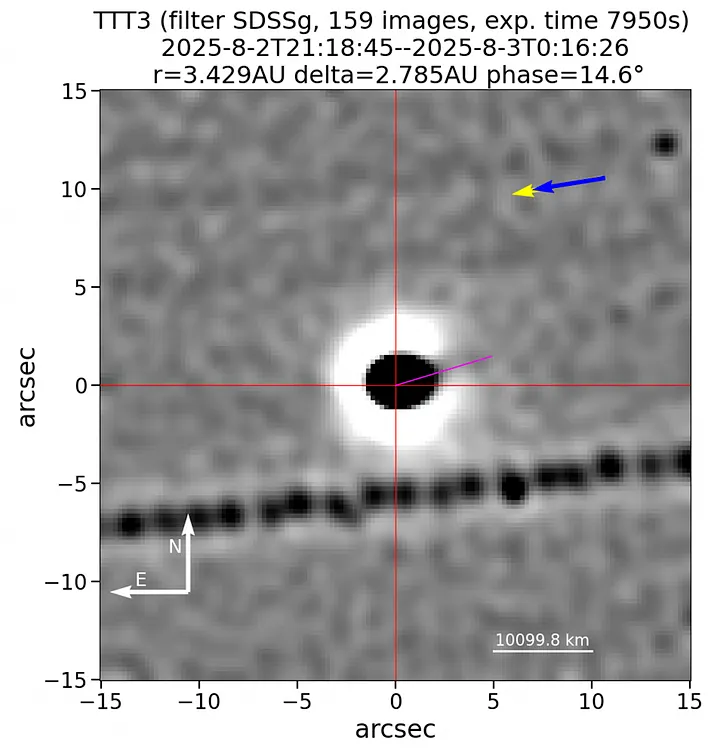
An image of the interstellar object 3I/ATLAS from the Two-meter Twin Telescope in the Canary Islands, Spain. The image, composed of 159 exposures of 50 seconds each, was taken on August 2, 2025. It shows a faint jet pointed towards the Sun (marked by a purple line), extending out to a projected distance of about 6,000 kilometers from the nucleus (indicated by the crossing point of the thin red lines). The direction away from the Sun (where a generic cometary tail should have pointed), is shown in yellow. (Credit: M. Serra-Ricart et al., October 15, 2025)
3I/ATLAS was discovered in June and confirmed by NASA in early July. It’s only the third interstellar object ever detected, meaning it came from outside our solar system. At roughly 5 to 11 kilometers wide, it’s also the biggest one yet. Some scientists believe it could date back billions of years, formed long before our Sun existed.
While a handful of online theorists have suggested it might be something artificial, experts say the comet is behaving exactly as a natural one should. Miquel Serra-Ricart, an astrophysicist at the Teide Observatory who helped capture the images, explained that the jet’s sunward direction is perfectly normal. As comets approach the Sun, their icy surfaces heat unevenly. When a weak spot gives way, trapped gases inside vaporize and burst outward like a geyser, creating jets that can point in almost any direction.
The newly spotted jet, which may stretch over 10,000 kilometers, is likely made of carbon dioxide and dust. That mix matches readings taken by the James Webb Space Telescope earlier this year, which detected a huge plume of gas surrounding the comet. According to Serra-Ricart, 3I/ATLAS’s jet will probably keep changing shape as the comet spins and moves closer to the Sun, a process that can make the ejected material fan out dramatically.
3I/ATLAS passed Mars in early October and will reach its closest point to the Sun on October 29. It’s currently hidden behind the Sun from Earth’s view but will reappear in mid-November. When it does, astronomers expect to see whether its close encounter has transformed it again – maybe even turning that jet into an even longer tail.


 overlaid with the new Two-meter Twin Telescope image of the comet’s jet (inset). (Image credit: Comet photograph: International Gemini Observatory/NOIRLab/NSF/AURA/Shadow the ScientistImage Processing: J. Miller & M. Rodriguez (International Gemini Observatory/NSF NOIRLab), T.A. Rector (University of Alaska Anchorage/NSF NOIRLab), M. Zamani (NSF NOIRLab); Inset: Teide Observatory, M. […]&media=https://wonderfulengineering.com/wp-content/uploads/2025/10/3i-atlas-3.webp)