

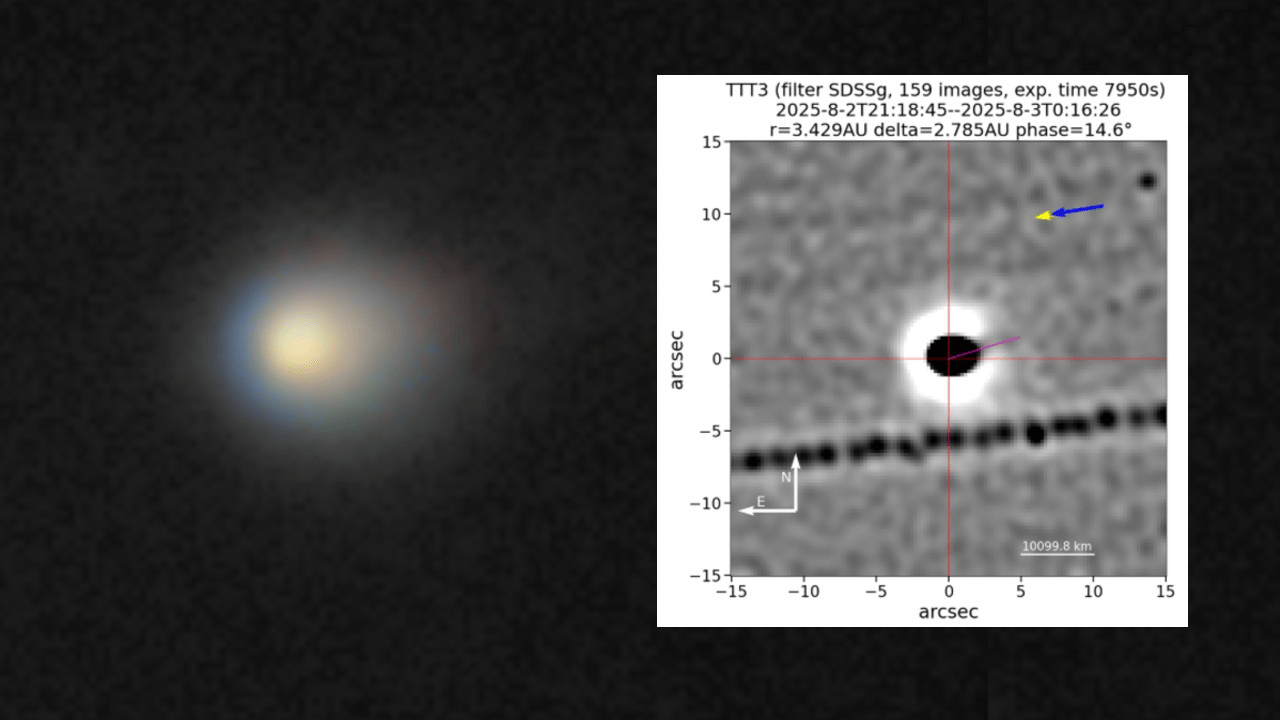
The interstellar traveler, Comet 3I/ATLAS, is paying a brief visit to our solar system and though it poses no threat to Earth, scientists are seizing the opportunity to learn from it. A NASA-coordinated campaign, led by the International Asteroid Warning Network (IAWN), will observe the comet as it streaks through space between late 2025 and early 2026, and the data could help protect us against dangerous asteroids in the future.
Comet 3I/ATLAS marks only the third known interstellar object ever detected entering our solar system. Unlike local comets, which orbit the sun, interstellar objects originate beyond our cosmic neighborhood visitors from other star systems briefly passing through before speeding back into deep space.
According to NASA’s update via the Minor Planet Center on October 21, “The campaign will target comet 3I/ATLAS (C/2025 N1) to exercise the capability of the observing community to extract accurate astrometry.” In simple terms, astronomers will use this campaign to fine-tune the art of astrometric measurement precisely tracking the comet’s position and movement across the sky relative to nearby stars.
The data collected will help scientists practice predicting orbital paths, a skill that could prove critical in identifying and mitigating future threats from asteroids or comets on potential collision courses with Earth.
IAWN describes itself as a “worldwide collaboration of asteroid astronomers and modelers”, established following United Nations recommendations for coordinated global responses to near-Earth object (NEO) threats. While 3I/ATLAS is no danger to us, its journey through the inner solar system offers an ideal opportunity to test international coordination and technical readiness.
At its closest approach roughly 1.8 astronomical units (the distance between the Earth and the Sun) the comet will still be far from our planet but bright enough to be observed using modest telescopes. However, observing comets is notoriously difficult. Their glowing comas and dust tails distort brightness measurements, making it harder to predict their exact paths.
To overcome these challenges, NASA and IAWN are inviting both professional and citizen scientists to participate in the observation campaign. Volunteers can register until November 7, with an initial workshop scheduled for November 10, followed by a series of teleconferences throughout the campaign period.
Even amid the ongoing U.S. government shutdown, NASA’s planetary defense operations continue. As the agency notes, tracking comets and asteroids remains a priority vital for global safety and scientific advancement.


, will observe the comet as it streaks through space between late 2025 and […]&media=https://wonderfulengineering.com/wp-content/uploads/2025/10/image-199.png)