

The University of St Andrews has taken a major step forward in making holographic technology more practical and accessible. By combining Organic Light-Emitting Diodes (OLEDs) with holographic metasurfaces, researchers have unveiled a simpler, cheaper, and far smaller method of producing holograms.
Holograms have long been associated with laser-based systems, which, despite their effectiveness, tend to be bulky and expensive. The research team at St Andrews has shown that by integrating OLEDs with holographic metasurfaces, it is possible to create a more streamlined system that is not only cost-efficient but also versatile. Their findings, published in the journal Light: Science and Applications, outline the creation of a new optoelectronic device that could open the door to holography on a much wider scale.

OLEDs are already a familiar presence in consumer technology, widely used in smartphones and televisions for their vivid displays. Their slim design and ability to emit light across a flat surface make them particularly attractive for emerging applications such as optical communication, sensing, and biophotonics. When paired with holographic metasurfaces—thin layers of nanoscale structures called meta-atoms designed to control the behavior of light—the potential grows even greater.
Each meta-atom, just a thousandth the width of a human hair, can manipulate light passing through it in precise ways, acting as an individual pixel in the holographic surface. By shaping and adjusting these interactions, the researchers were able to generate pre-designed holographic images using the principle of light interference. This allows detailed patterns and images to emerge, all from a compact, integrated device.
The team expressed their enthusiasm about the breakthrough. Professor Ifor Samuel explained that they were “excited to demonstrate this new direction for OLEDs,” noting that the combination with metasurfaces not only created a new way to generate holograms but also provided a novel method of shaping light itself. Professor Andrea Di Falco emphasized the broader implications, calling holographic metasurfaces “one of the most versatile material platforms to control light” and pointing out that this research removes a significant technological barrier that has so far limited the everyday adoption of metamaterials. He stressed that this discovery could lead to a dramatic change in how holographic displays are built for applications such as virtual and augmented reality.
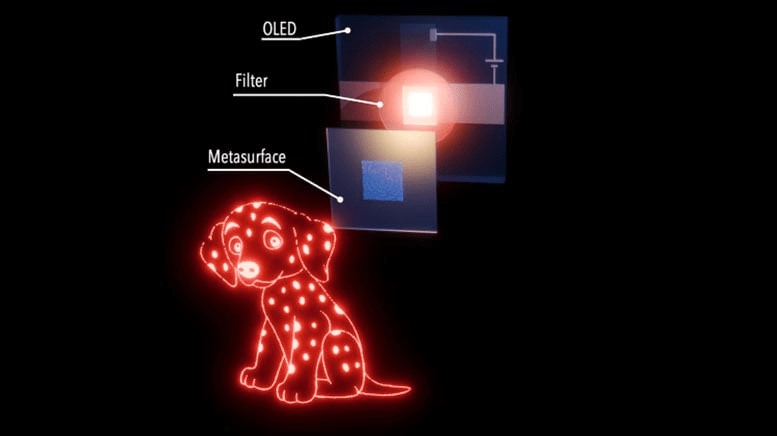
Meanwhile, Professor Graham Turnbull underlined the efficiency of the new method, observing that while traditional OLED displays typically require thousands of pixels to form a simple picture, this technique makes it possible to project an entire image from a single OLED pixel.
Until now, the limitations of OLEDs meant that only basic shapes could be produced, restricting their usefulness for holography. With this advance, however, the path is clear for miniaturized and highly integrated holographic systems that may one day become commonplace in everyday technology.


 with holographic metasurfaces, researchers have unveiled a simpler, cheaper, and far smaller method of producing holograms. Holograms have long been associated with laser-based systems, which, despite their effectiveness, tend to […]&media=https://wonderfulengineering.com/wp-content/uploads/2025/09/image-56.png)