

Elon Musk’s vision of populating Mars with autonomous humanoid robots may sound like a scene from science fiction but robotics experts warn that it’s far from reality.
In a recent interview with Forbes, Christian Hubicki, who heads the Optimal Robotics Laboratory at Florida State University, dismissed Musk’s interplanetary robotics dream as premature and unrealistic.
“Humanoids fall down. They break. Their code crashes,” Hubicki said. “Right now, humanoids aren’t reliable enough to be autonomous on Earth, let alone Mars.”
Hubicki’s remarks come as Musk continues steering Tesla deeper into robotics and artificial intelligence — even betting the company’s future on its Robotaxi service, which he claims will generate trillions in value. However, these self-driving cars have yet to operate fully without human oversight and have already been linked to multiple accidents.
Musk’s Optimus humanoid robot represents the other half of his AI-driven future. He has promised Tesla will be producing 100,000 units per month by next year, a projection many view as overly optimistic. Critics note that even the most advanced robotics companies have struggled to mass-produce humanoids, let alone find a viable market for them. A recent demonstration video of Optimus showed the robot moving slowly, responding awkwardly, and even glitching mid-sentence — far from the agile, intelligent worker Musk envisions.
In keeping with his grand ambitions, Musk has integrated these robots into his broader goal of colonizing Mars and “expanding consciousness to the stars.” Earlier this year, he announced that Optimus units will be sent aboard SpaceX’s Starship rockets by the end of 2026 to begin exploring and preparing the Martian surface for future settlers.
While Musk conceded that “a lot needs to go right,” he posted on X (formerly Twitter) that he expects the first uncrewed Mars flight in about 3.5 years and a crewed mission roughly two years after that, claiming a “self-sustaining Mars city” could emerge in 20 to 30 years.
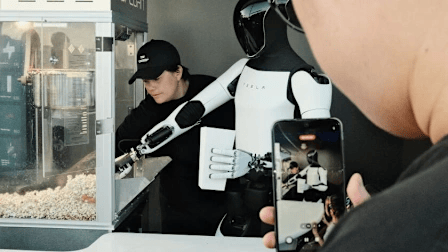
But Hubicki isn’t convinced. He pointed out that even NASA’s space-tested humanoids required constant human assistance. “Critically, on the International Space Station, humans are there to help and fix the robot when it inevitably falters,” he explained. “On Mars, there are no humans to rescue it, and replacement parts are a nightmare to ship in.”
He cited NASA’s Robonaut, which was used aboard the ISS but relied heavily on teleoperation and was limited to basic maintenance tasks. In short: humanoid robots are still too fragile and unreliable to survive let alone thrive in Mars’s harsh, isolated environment.
While Hubicki doesn’t dismiss the long-term potential of humanoid explorers, he believes Musk should start smaller. “If I were in his shoes, I’d send humanoids to the Moon first, where they can at least cut their teeth,” he said.
He also emphasized that humanoid shapes aren’t always the best fit for extraterrestrial exploration. NASA engineers, for example, are developing snake-like robots capable of slithering into vents on Saturn’s icy moon Enceladus or the Martian ice caps — designs far better suited to rugged, alien terrains.
Ultimately, as Hubicki put it, human-shaped robots are still a long way from self-sufficiency.
“Without a major technological leap in humanoid reliability,” he told Forbes, “an unaccompanied humanoid on Mars wouldn’t be functional for long.”


