

In a quiet but powerful statement about the future of flight, a small aircraft recently completed a historic journey across Denmark. To the average observer, it looked like any ordinary plane cruising through the sky. But this wasn’t just another aircraft—it was Denmark’s first all-electric test flight.
Designed by U.S.-based Beta Technologies, the fixed-wing electric plane, ALIA CTOL, flew 200 kilometers from Sønderborg to Copenhagen without burning a single drop of fuel.
“Many say that green aviation is something for the future,” said Jákup Sverri Kass, director of Sønderborg Airport, as the plane took off. “But we are standing here today and seeing that the future has begun. This is not just a test. This is the start of something new.”
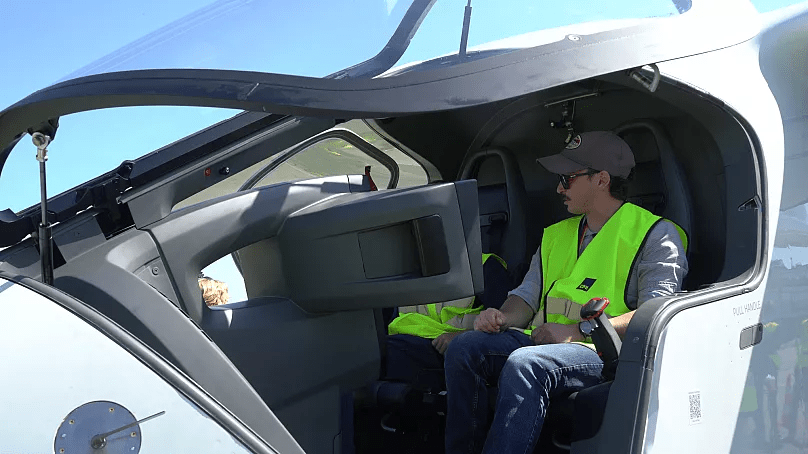
The ALIA CTOL is more than a prototype; it’s a fully operational electric plane that offers a practical and scalable solution to short-range air travel. According to its developers, the aircraft can be recharged in just 20 to 40 minutes using a standard fast charger for electric vehicles, a fact that immediately sets it apart in a field long dependent on fossil fuels and complex logistics.

With a wingspan of 15 meters and the footprint of a Sprinter van, the plane is compact yet efficient. It can reach a top speed of 281 kilometers per hour and has already completed a flight of up to 622 kilometers on a single charge. Designed to carry either cargo or up to five passengers, the aircraft is touted as being safe, quiet, and significantly more affordable to operate than traditional aircraft or helicopters. It also emits up to 84 percent less carbon dioxide than a similarly sized helicopter, making it a much greener alternative for regional travel.
The historic Danish flight was part of the plane’s ongoing European tour, which began in May from Shannon Airport in Ireland. The goal of the tour is to showcase not just the aircraft itself but the entire ecosystem required for all-electric aviation. In August, the ALIA CTOL will begin operating cargo routes between Bergen and Stavanger in Norway under a test program led by the Norwegian Civil Aviation Authority.
However, the most pressing challenge remains infrastructure. Currently, the ALIA CTOL carries its charging unit because most European airports are not yet equipped with permanent charging stations. This self-sufficiency allows it to demonstrate functionality but underscores a significant gap in readiness across the continent. Shawn Hall, Beta Technologies’ chief revenue officer, pointed out that, unlike the United States, Europe still lacks the necessary charging networks to support electric planes at scale.
In Copenhagen, airport CEO Christian Poulsen acknowledged that changes are coming. The airport, he said, will need to invest in infrastructure to support both conventional and electric aircraft, especially as demand grows. Jørgen Mads Clausen, chair emeritus of Danish technology giant Danfoss, added that while battery costs and materials remain hurdles, progress is inevitable. He emphasized the importance of preparedness, stating, “Just like with electric cars, it’s important to be ready when things take off. Because when the technology matures, things will move fast.”
This momentum aligns with broader government goals. Denmark has committed to launching its first fully sustainable domestic flight route by 2025 and aims to make all domestic routes fossil-free by 2030. To help fund this transition, a modest fee of 13 Danish kroner, about €1.74, is now added to each domestic airline ticket.
Elsewhere in the Nordic region, similar commitments are driving innovation. Norway aims for all domestic flights to be electric or hybrid by 2040. Sweden has even more aggressive targets, planning for all domestic flights to be fossil-free by 2030 and international routes to follow suit by 2045. In line with this vision, Swedish-American company Heart Aerospace is developing the ES-30, a 30-passenger aircraft designed to travel up to 200 kilometers entirely on battery power.
Even beyond the Nordics, countries like the Netherlands, France, and the United Kingdom are testing small electric aircraft and investing in future-ready aviation technology. However, given the current battery limitations, electric planes are best suited for regional travel within Europe. This means other innovations, such as sustainable aviation fuels (SAF) and hydrogen-based propulsion, are likely to play key roles alongside electric aviation.
Lasse Stenhøj Ingvardsen, team manager for Renewable Energy Systems at the Danish Technological Institute, emphasized the importance of embracing multiple solutions. “The SAF fuel will be one tool. The electric will be another tool. The hybrid solution will be a third tool. Maybe we will see hydrogen planes. We don’t need to stick to only one,” he said.


