

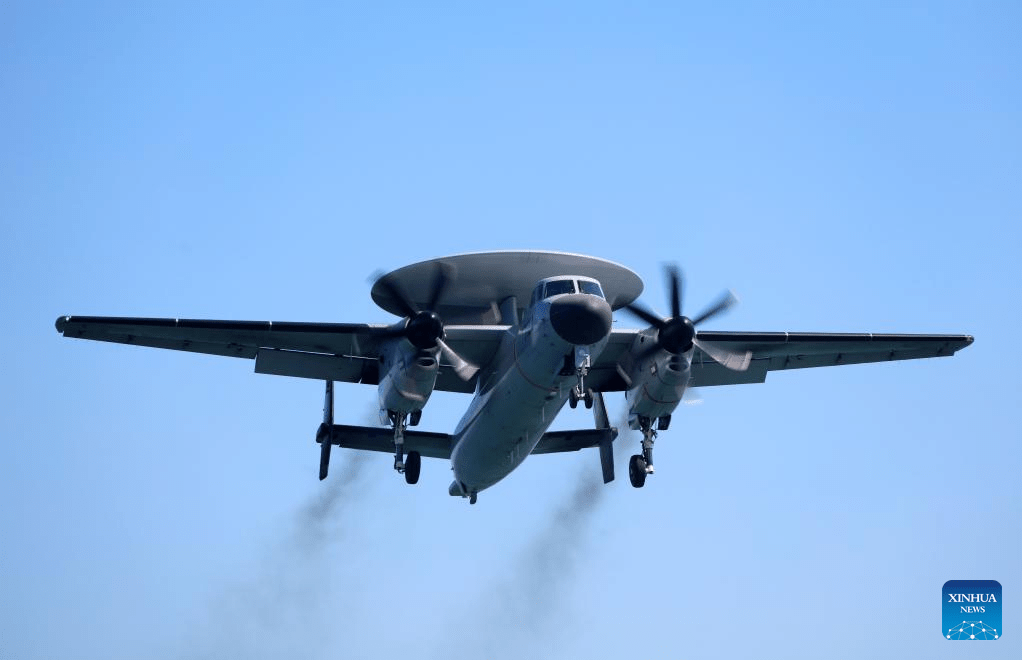
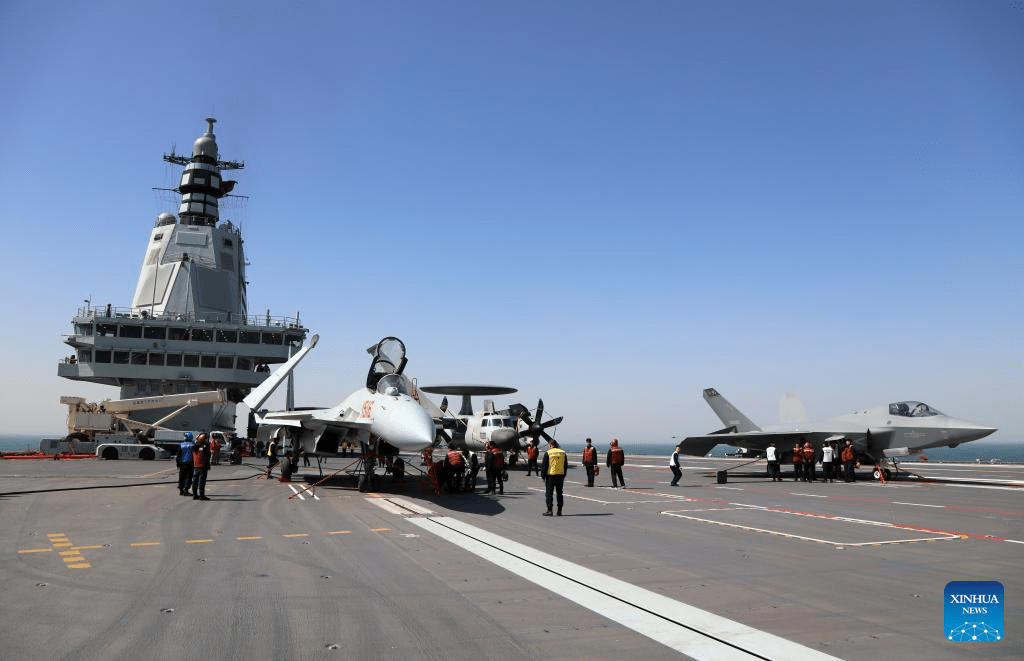
China has taken a significant leap in its naval modernization with successful tests of its newest and most advanced aircraft carrier, the Fujian. For the first time, state broadcaster CCTV released footage showing the ship’s electromagnetic catapult system (EMALS) in action, launching three different aircraft types.
The footage, aired Monday, revealed the J-35 stealth fighter, the J-15T fighter, and the KJ-600 early warning aircraft taking off from the Fujian using EMALS technology. State media celebrated the achievement as a “breakthrough” and a “milestone” in China’s carrier program, underscoring its shift toward more advanced naval capabilities.
So far, the USS Gerald R. Ford commissioned by the U.S. Navy is the only other carrier in the world equipped with EMALS, which was certified for operations in 2022. Unlike the traditional ski-jump ramps on China’s older carriers, Liaoning and Shandong, the new system enables jets to take off with heavier fuel and weapons loads, greatly expanding their combat range.
Analyst Carl Schuster, a former U.S. Navy captain, noted that the Fujian’s successful trials, including both catapult launches and arrested landings, suggest the ship could officially enter the People’s Liberation Army Navy (PLAN) fleet within weeks. He added that more certifications are likely over the next few months, with full integration exercises expected in the spring.
“The successful tests…mean the ship’s commissioning…could be only a few weeks away,” Schuster said.
The EMALS system gives Fujian the ability to project power farther into the Pacific, a capability analysts describe as extending China’s “blue-water” reach. By enabling the launch of larger aircraft with greater payloads, the carrier significantly outperforms China’s earlier designs.
Still, a key difference remains: while U.S. carriers are nuclear-powered, allowing them to stay at sea indefinitely, the Fujian relies on conventional fuel and must dock or be refueled at sea.
The Fujian’s progress coincides with a visit by a U.S. congressional delegation to Beijing — the first in six years aimed at strengthening military-to-military communication. Leading the group, Representative Adam Smith highlighted the importance of dialogue to avoid escalation: “China is the most rapidly growing military and the most rapidly growing nuclear power in the world… It is dangerous for us not to be having regular communications… so that miscalculations and misunderstandings don’t lead to larger problems,” he said.
Smith also warned of increasing risks due to close encounters between U.S. and Chinese ships and aircraft, stressing: “We need to have a better conversation about de-conflicting those things.”
Chinese Defense Minister Dong Jun, meanwhile, urged Washington to “remove disruptive and restrictive factors” and take “constructive and pragmatic steps” to improve relations, according to state media.
The congressional visit follows a recent phone call between President Donald Trump and Chinese leader Xi Jinping, during which both sides discussed upcoming summits. Trump confirmed he would meet Xi at the APEC summit in South Korea next month, with reciprocal visits planned for the near future.


 in action, launching three different aircraft types. The footage, aired Monday, revealed the J-35 stealth fighter, […]&media=https://wonderfulengineering.com/wp-content/uploads/2025/09/image-134.png)