

A new frontier in humanoid robotics has been unlocked with the unveiling of the L7 robot by Chinese robotics startup Robotera. Touted as the world’s fastest humanoid robot, capable of sprinting at 9 mph, the L7 is a marvel of balance, agility, and mechanical precision.
At the heart of L7’s capabilities is a groundbreaking integration of what Robotera calls a “body plus brain” unified architecture. This innovation allows the robot to perform human-like, high-energy movements such as 360-degree spins and breakdancing all while maintaining excellent balance and coordination. A report by China Daily spotlighted the robot’s finesse, underscoring its athletic precision and refined mechanics. In a demonstration video, the L7 excelled at sorting objects on a conveyor belt and tightening nuts onto a wheel hub using a power tool both complex tasks requiring sharp spatial awareness and fine-tuned torque control.
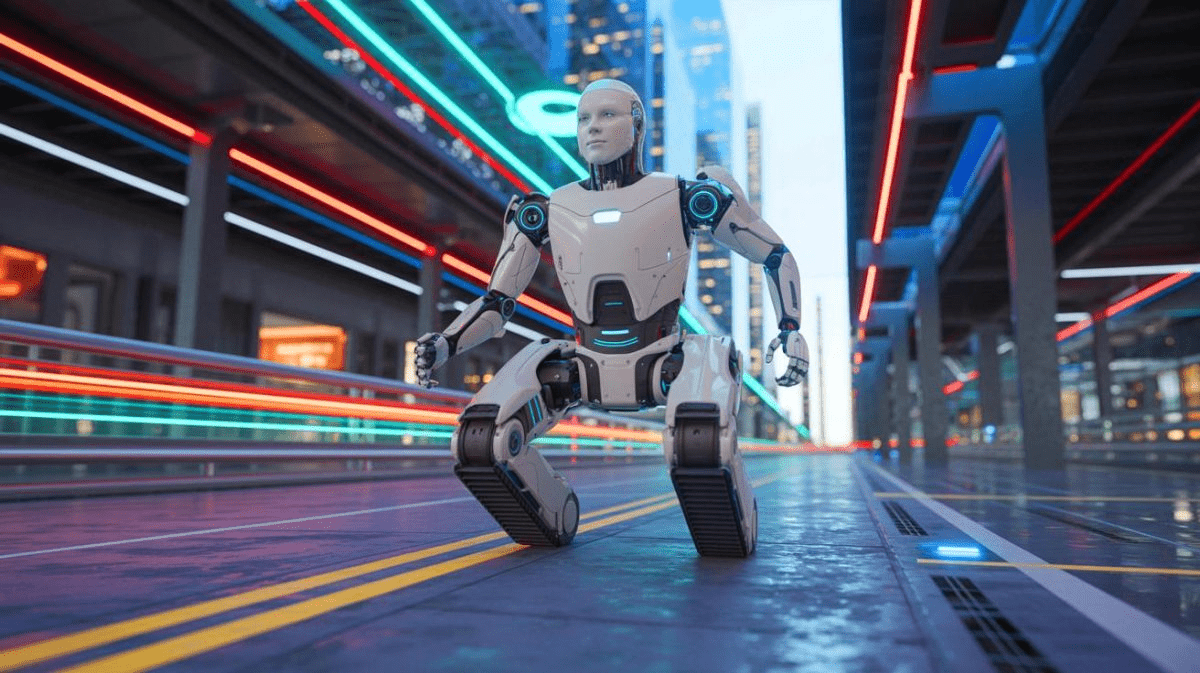
Its ability to outrun a human on a flat surface in the same video served as a striking indicator of how far bipedal mobility in robotics has come. The robot’s natural movements and controlled speed emphasize its potential for real-world applications across logistics, manufacturing, and even public-facing services.
Evolving from Robotera’s earlier STAR1 model, the L7 steps up its game by combining athletic speed with enhanced upper-limb dexterity. With 55 degrees of freedom and joint torque output reaching 400 Nm, it handles both graceful motions and heavy lifting capable of transporting up to 44 pounds using both arms. This allows it to perform delicate operations like ripping paper towels or drawing curtains, as well as handling industrial-grade tasks.

Its multi-sensor fusion system, including panoramic vision and depth sensors, grants the L7 full 360-degree situational awareness essential for dynamic environments. While the exact battery life is still unknown, the swappable battery system ensures the L7 can remain in action with minimal downtime. For more specialized or research-driven applications, Robotera also offers the M7, a modular upper-body version that can be upgraded to a full L7 unit.
The L7 is not just built for the factory its performance and design also cater to showmanship and adaptability. The robot is able to transition effortlessly from industrial tasks to public demonstrations, showing off its choreographed dance moves and fluid humanlike gestures. Such versatility was previously demonstrated with the STAR1 model, which made headlines in March 2025 for outpacing a barefoot humanoid rival and using chopsticks with precision.

By merging strength with finesse, the L7 is equally suited for tasks in manufacturing, logistics, and customer service—and perhaps even the entertainment industry.


