

Since launching in May 2023, the ChatGPT mobile app has generated around 2 billion dollars in global consumer spending across iOS and Android. That performance makes it the clear leader in the consumer AI app market, with earnings roughly 30 times higher than competitors like Claude, Copilot, and Grok.
The acceleration in 2025 has been remarkable. Between January and July, ChatGPT brought in 1.35 billion dollars, a 673 percent year-over-year increase compared to the 174 million dollars earned in the same period last year. On a monthly basis, revenue now averages 193 million dollars, up sharply from 25 million dollars per month in 2024.
Comparisons with rivals highlight just how far ahead OpenAI’s app is. Grok, for instance, has earned only 25.6 million dollars in total revenue this year, averaging 3.6 million dollars per month. That amounts to less than two percent of ChatGPT’s monthly earnings.
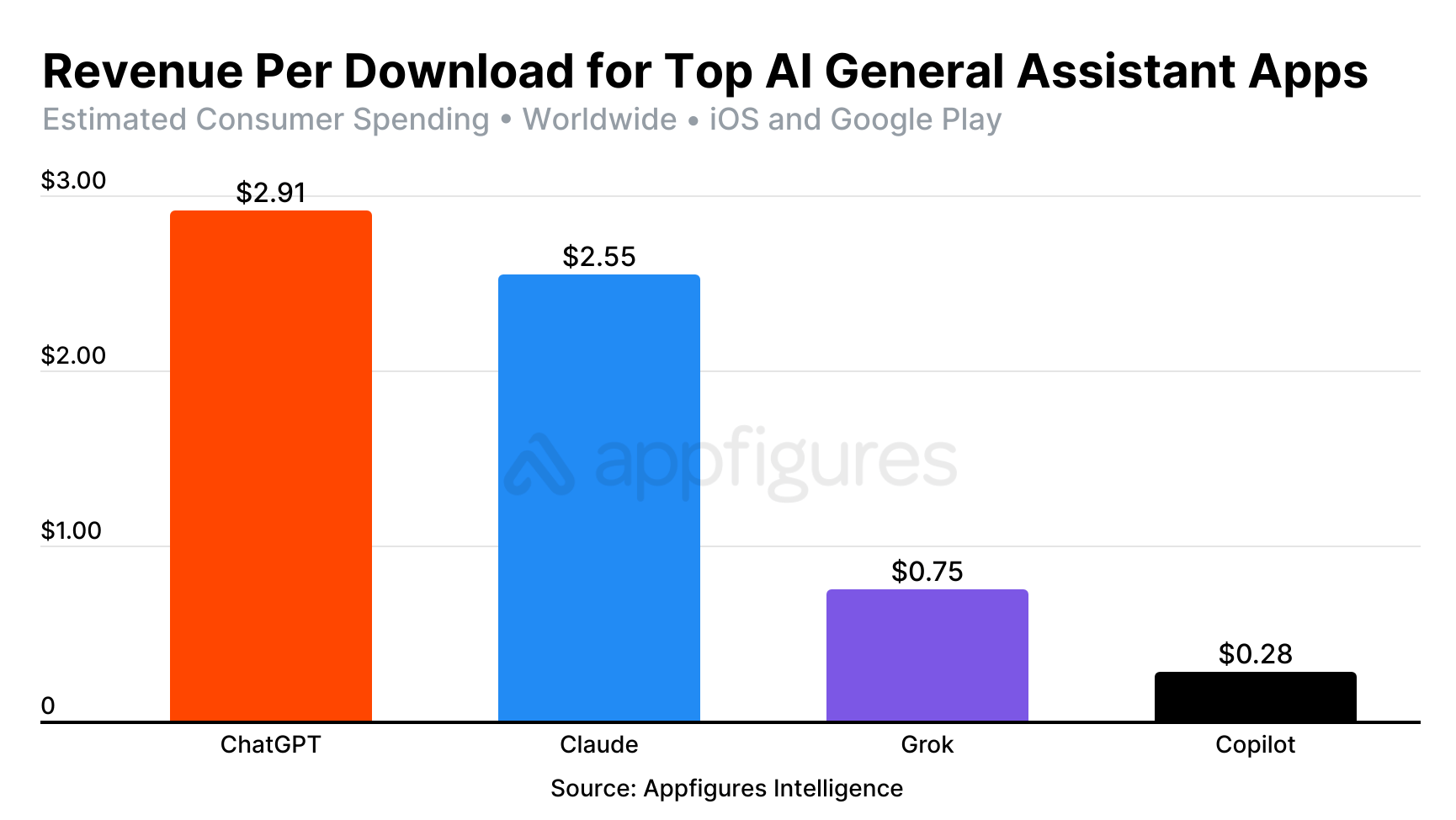
Image Credits: Appfigures
Another useful measure is revenue per install. ChatGPT currently earns 2.91 dollars for each download, while Claude generates 2.55 dollars, Grok 0.75 dollars, and Copilot just 0.28 dollars. Regional spending also varies significantly. The United States accounts for 38 percent of global revenue, with each download there averaging about 10 dollars. Germany follows as the second-largest market with 5.3 percent of revenue.
Install growth has been equally strong. ChatGPT has been downloaded more than 690 million times worldwide, compared to Grok’s 39.5 million installs. Monthly downloads are currently around 45 million, almost triple the 2024 average of 16 million. So far in 2025, ChatGPT has added 318 million new installs, 2.8 times higher than during the same period last year. India leads in total installs with 13.7 percent, while the United States holds second place at 10.3 percent.
For engineers, these numbers show the impact of pairing strong AI models with scalable mobile distribution. High revenue per install points to user willingness to pay for premium features and ongoing engagement. Achieving this level of growth also requires resilient backend systems capable of handling large compute loads, minimizing latency, and maintaining uptime across a global user base.
The trajectory of ChatGPT’s mobile app illustrates how technical design, infrastructure planning, and user experience combine to drive both adoption and monetization. In less than two years, it has become a multi-billion-dollar case study in how AI products can scale when engineering and product strategy align effectively.


