

According to a report from Business Insider, small fiber-optic-controlled drones have become so common on the front lines in Ukraine that they are now leaving tangled trails of cable across fields, roads, and trenches, forcing troops to move with serious caution.
These wired drones emerged as a response to heavy electronic warfare. Early in the war, both sides relied heavily on FPV quadcopters guided by radio signals, often carrying explosive warheads designed to dive directly into vehicles and fighting positions. Once powerful jamming systems made many of those drones useless, operators switched to cable-linked versions that are nearly impossible to disrupt electronically.
Because fiber-optic drones maintain a physical connection between the drone and its operator, they cannot be jammed in the conventional sense. The cable acts as a secure data line, guaranteeing control even when electronic interference is saturating the air. The drawback, however, is that every flight leaves long strands of cable draped across the environment.
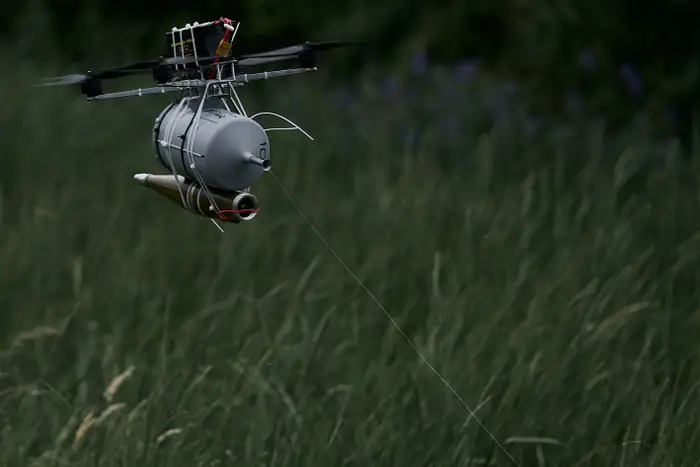
Fiber-optic drones are connected to their operators by long, thin cables. Kostiantyn Liberov/Libkos/Getty Images
Ukrainian special operations troops say this has now become a tactical hazard in itself. Khyzhak, a member of Ukraine’s 4th Ranger Regiment — identified only by his call sign — told Business Insider that soldiers often cannot immediately tell whether a cable belongs to a drone or forms part of a booby-trap. Mines are everywhere, and Russian forces frequently disguise explosive triggers beneath wires or lines.
“You see the webs, and you never know what it is,” he said, recalling an incident in which his team evaded a Russian strike drone while returning from a mission. Video shared by his unit shows fiber-optic lines caught on vegetation, lying beside dirt roads, and even wrapped across his rifle.
At night, this becomes far more dangerous. Operators cannot simply shine lights to inspect the ground, so every strand of cable slows movement, forces pauses, or even requires engineers to clear the path. Some routes have been covered with protective netting to shield vehicles below, though this is not foolproof.
Fiber-optic drones are now extending their reach. Russian units have begun fielding variants with ranges near 50 kilometers, which suggests far longer cable spools than earlier models. In response, Ukrainian engineers are developing detection systems and possible countermeasures, including cutting techniques, physical shielding, and route-monitoring devices.
These innovations are now being studied beyond the battlefield. NATO planners are actively reviewing how fiber-linked weapons could shape future warfare, where jamming is expected to be constant and direct physical control may be the only reliable way to guide unmanned weapons.


