

Via Shutterstock
Scientists have identified what could be one of the most promising locations on Mars to search for ancient life: a set of colossal water-carved caves buried beneath the surface of the Red Planet. These enormous caverns, located in the Hebrus Valles region, appear to have formed billions of years ago when slightly acidic water dissolved vast layers of carbonate and sulfate bedrock. Their discovery, described in The Astrophysical Journal Letters, marks the first time such karstic caves have been identified on Mars, as reported by Space.com.
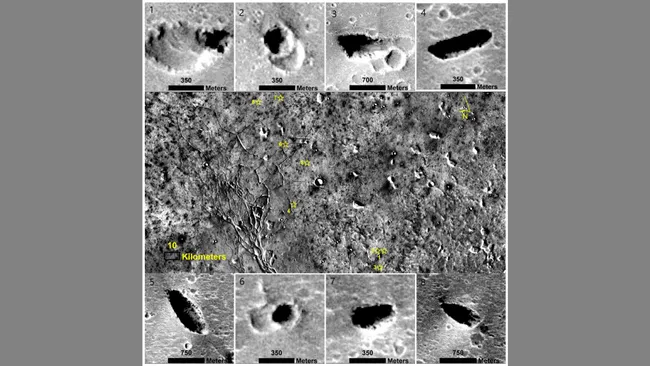
Images of the eight skylights opening up into possible karstic caves in Hebrus Valles on Mars. (Image credit: Sharma et al (2025).)
The caves were detected through eight large skylights, openings on the Martian surface that range from several dozen to over 100 meters wide. Unlike impact craters, these skylights lack raised rims or ejecta fields, suggesting that they formed when the ground collapsed into empty chambers beneath it. According to researchers from Shenzhen University, these structures represent some of the most compelling environments yet found for preserving ancient biosignatures.
The team combined mineral maps, hydrogen data, and high resolution terrain models gathered by missions such as Mars Odyssey, Mars Reconnaissance Orbiter, and the now retired Mars Global Surveyor. Their analysis revealed that Hebrus Valles is rich in limestone, gypsum, and other minerals laid down more than 3.5 billion years ago when Mars hosted lakes and seas. Over time, surface water froze into underground ice, but periodic heating events from distant volcanism, impacts, or orbital changes likely melted these buried reserves. The resulting water flowed through cracks in the rock, carving out massive cavern systems that have remained intact ever since.
Scientists say these caves could be ideal places to search for evidence of past Martian life. Their stable internal environment would have protected any ancient microbial colonies from extreme temperature swings, dust storms, and damaging radiation. Even today, the caves remain shielded, making them valuable not only for astrobiology but also for future astronaut habitats.
Exploring them will not be easy. Thick rock will limit communications with orbiting spacecraft, and many skylights descend into steep vertical shafts. Still, the team notes that some appear to contain stepped rubble slopes that could allow cautious robotic descent. A combination of wheeled rovers, climbing robots, or small rotorcraft could form relay chains to maintain contact while venturing deeper underground.
Researchers believe Hebrus Valles is not unique and that more water formed caves likely exist across Mars. If confirmed, these hidden caverns may hold the clearest remaining record of a time when Mars was warm, wet, and potentially alive.
Their findings have been published here.


