

According to details published by CERN, the world’s largest and most powerful particle accelerator is now doing more than smashing subatomic particles. It is also quietly heating thousands of homes in eastern France by recycling the massive amounts of waste heat generated during its operations.
Since mid January, the Large Hadron Collider, better known as the LHC, has been supplying thermal energy to homes and businesses in Ferney-Voltaire through a newly activated heat exchange system. Instead of letting excess heat escape into the atmosphere, engineers are capturing it and redirecting it into the town’s district heating network.
The concept is surprisingly simple. The collider’s equipment, especially its cryogenic and cooling systems, must be constantly chilled with circulating water. As the water absorbs heat from the machinery, it warms up. Traditionally, that hot water would head to cooling towers where the heat would simply be released into the air. Now, it passes through powerful heat exchangers that transfer the energy to the town’s heating infrastructure.
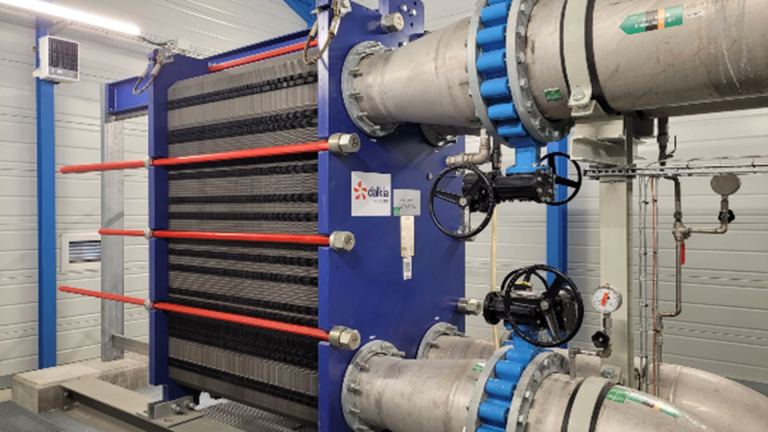
The connection point sits near the French Swiss border at one of the collider’s surface sites known as Point 8. From there, the recovered heat flows directly into the local grid, warming residential and commercial buildings. The system can currently deliver up to five megawatts of heat, enough to serve the equivalent of several thousand households, with the potential to double that when the accelerator is running at full capacity.
What makes the project notable is that the LHC was never designed as an energy plant. Its primary job is to accelerate protons to near light speed and study the fundamental structure of the universe. But the enormous energy demands of that science create a byproduct that turns out to be highly useful.
Even during planned shutdowns, when physics experiments pause for upgrades, parts of the infrastructure still require cooling. That means heat recovery can continue for much of the year. Officials say the system will help prevent thousands of tons of carbon dioxide emissions by reducing reliance on conventional heating fuels.
The initiative is part of a broader push by CERN to improve energy efficiency and reuse waste heat across its facilities. By treating excess energy as a resource rather than a problem, the lab is showing how even the most cutting edge research centers can contribute to practical climate solutions.
In this case, the same machine that probes the secrets of the universe is also keeping families warm through the winter.


