

Sometimes, the simplest solution is the most effective, and the US Army has proven this point by deploying a unique method to deter wildlife from air bases. Initially, the Army experimented with high-tech robots like the Boston Dynamics’ Spot robot, designed to resemble a dog, to chase away problematic birds and other wildlife. However, they quickly realized that these advanced robots lacked the speed needed to effectively scare off animals, especially birds that could cause significant damage to aircraft.
Instead, the Army turned to a more practical and affordable solution: plastic coyote decoys mounted on mini four-wheelers. These “Coyote Rovers,” as they are called, offer a far more effective method of wildlife deterrence. The small, autonomous vehicles, which are about the size of toy cars, are equipped with life-sized plastic coyote models. The motion of the vehicles and the realistic appearance of the decoys make them convincing enough to frighten wildlife away from airfields.
Wildlife strikes have been a major concern for the military, particularly birds. In 2014, four Air Force servicemen tragically lost their lives when a flock of geese collided with their helicopter. In total, between 2007 and 2016, the US Air Force reported over 45,000 wildlife strikes, costing millions in damages. In response, the military formed the Bird/Wildlife Aircraft Strike Hazard (BASH) team, dedicated to mitigating these risks. The BASH team, along with wildlife biologists, has been working on the Coyote Rover project for several years, aiming to find a solution that is both effective and cost-efficient.
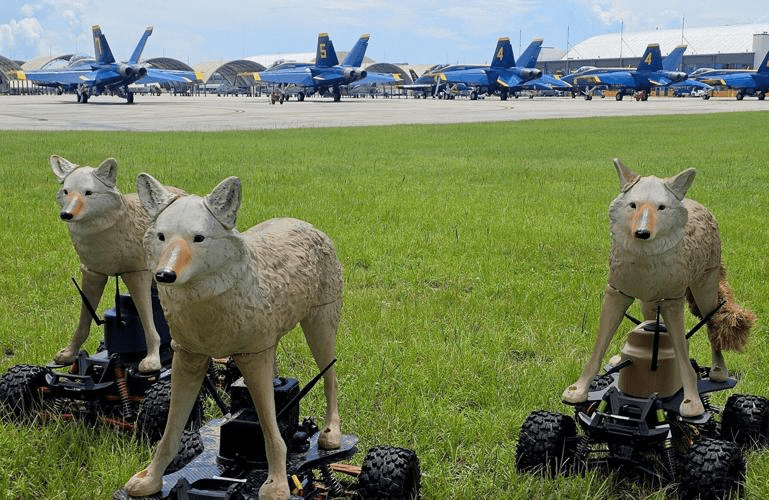
Unlike previous attempts using real dogs or the Spot robot, the Coyote Rover proved to be a better solution. The rovers can travel at speeds of up to 20 miles per hour, which is fast enough to chase away wildlife effectively. The cost of the Coyote Rover is also far lower than the Spot robot, which can cost upwards of $74,000. The rovers, by contrast, cost only around $2,500 to $3,000 each.
While still in its prototype phase, the Coyote Rover has already shown promising results in demonstrations at various air bases. Looking forward, the Army plans to enhance the technology by incorporating machine learning capabilities, potentially allowing the rovers to autonomously navigate charging stations and identify wildlife species. For now, though, the primary mission of the Coyote Rovers remains the simple yet effective task of keeping wildlife away from critical airfield areas.


