

In a bold move that merges imagination with engineering ambition, the United Arab Emirates has unveiled plans for a colossal underwater train that would stretch nearly 1,200 miles beneath the Arabian Sea, linking the Emirati port city of Fujairah with Mumbai, India’s bustling financial capital.
Dr. Ahmed Al Hariri of the UAE’s National Advisor Bureau captured the essence of the project by saying, “This is not just about transport, but an immersive experience.” Blending cutting-edge speed with panoramic views of marine life, the so-called “Deep Blue Express” aims to offer a journey as unforgettable as the destination itself.
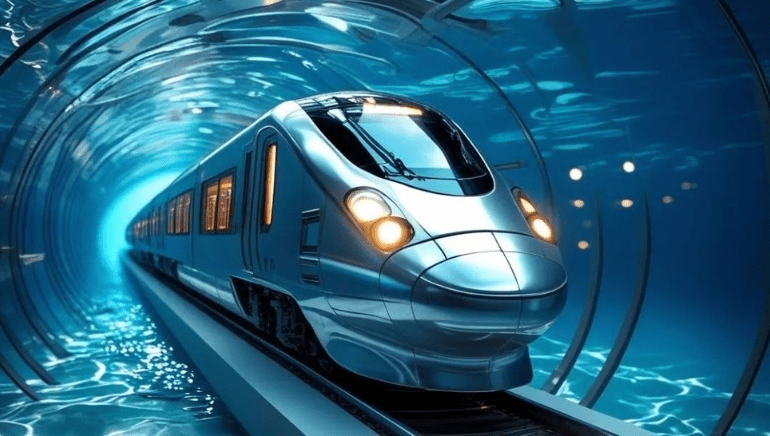
The proposed train will travel at speeds between 600 and 1,000 kilometers per hour, promising to outpace commercial flights while offering a far more scenic and serene experience. Inside the transparent tunnel, passengers would be treated to uninterrupted views of the underwater world, turning what is normally a tedious commute into a voyage through a living aquarium.
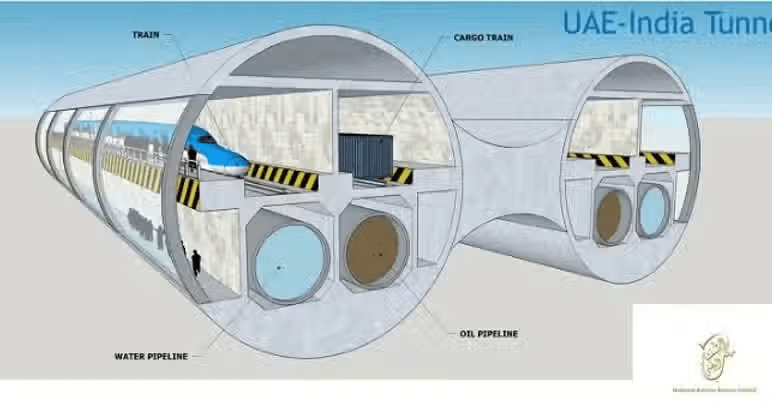
But this isn’t just about transporting passengers. The rail line would also serve dual purposes: carrying freshwater from India to the UAE and returning with oil and other goods, strengthening trade ties between the two nations. This multifunctional infrastructure adds significant economic weight to an already visionary concept.
The underwater train also deepens the UAE’s competitive stance in the region. With Saudi Arabia investing $1 trillion in its NEOM city and related futuristic projects, Dubai’s undersea venture challenges Riyadh’s dominance in innovation. As travel blogger Sara Ahmed put it, “The underwater train isn’t just about getting from point A to B. It’s about relishing the wonders of the marine world.”
This project, then, is more than a marvel of transportation it’s a diplomatic bridge, a tourism magnet, and a symbol of ambition. It ties directly into the UAE’s broader goal of diversifying its economy and redefining its place on the global innovation map.
Despite the spectacle and strategy, enormous challenges remain. Constructing a tunnel beneath the Arabian Sea involves dealing with intense pressure, underwater seismic risks, and complex environmental variables. The train must operate safely at incredible speeds and sustain structural integrity over thousands of journeys.
There’s also the human factor. For many, the idea of speeding through a sealed tube deep below the ocean is psychologically daunting. Mumbai businessman Rajesh Verma voiced a common concern: “I’ve always been wary of the ocean’s depths. As much as I love the idea, I’ll likely stick to conventional modes of transport.”
Still, Dubai has a proven track record. From building the world’s tallest building to the man-made Palm Islands, its leadership is no stranger to turning audacious ideas into reality. For them, the biggest barrier isn’t money it’s technological feasibility and environmental viability.
Early designs suggest the use of transparent tunnel materials a far cry from traditional opaque concrete or steel creating a 360-degree immersive marine viewing experience. This approach transforms the train from a commuter service into a bucket-list-worthy destination, fusing luxury with innovation.
If completed, the Dubai-Mumbai train would dwarf existing underwater rail infrastructure, including Japan’s Seikan Tunnel, which spans just 53.85 kilometers. In contrast, this train would cover more than 1,900 kilometers and travel at speeds ten times faster than Europe’s Channel Tunnel trains, which cruise at a modest 70 mph.
A feasibility report is now underway to assess the materials, safety standards, environmental impact, and construction logistics. This will be the first major step in determining whether the Deep Blue Express becomes a global symbol of progress or remains an ambitious dream.
What’s undeniable is the vision behind this project. At a time when the world is rapidly rethinking the future of cities, transport, and international collaboration, this undersea railway could become a blueprint for high-tech connectivity. It’s not just about making travel faster it’s about changing how we interact with geography, removing physical limitations, and bringing once-distant cultures closer than ever before.
Whether or not the Deep Blue Express reaches full realization, its proposal has already captured the imagination of millions and pushed the boundaries of what’s possible in engineering and diplomacy.


