

A Chinese robotics startup has unveiled what it claims is the world’s smallest full-body humanoid robot, signaling a shift toward personal robots designed to live with users rather than perform narrow industrial tasks. The new machines come from PrimeBot, a consumer-focused brand launched by AgiBot and formally introduced during CES 2026.
PrimeBot debuted two robots under its new Prime series: the Prime Q1 and Prime T1. Both are positioned not as fixed-function machines, but as adaptive companions intended to learn, evolve, and develop behavior over long-term interaction with their owners. The company describes the robots as personal systems that users can shape over time, rather than sealed products with predefined roles.
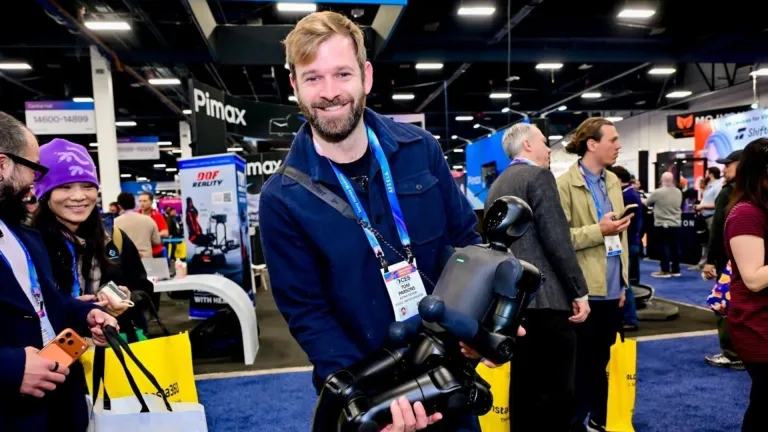
The Prime Q1 is the centerpiece of the launch and is described as the world’s smallest force-controlled humanoid robot with a complete body. Built for developers, educators, and robotics enthusiasts, it features compact full-body articulation, force-sensitive joints, and an open architecture designed to support experimentation. Users can modify both hardware and software, including optional 3D-printed shells, allowing the robot’s appearance, movement style, and personality to evolve alongside its owner.
Rather than focusing on raw computing benchmarks, PrimeBot emphasizes embodied intelligence. This approach prioritizes learning through physical interaction with real environments, enabling the robot to adapt its behavior based on touch, motion, and repeated social engagement. According to the company, this is key to making humanoid robots viable outside laboratories and industrial settings.
The Prime T1 takes the concept further into everyday use. Marketed as the world’s first consumer-grade transformable robot, it can switch between a wheeled humanoid form for indoor spaces and a quadruped configuration designed for outdoor mobility. This allows it to handle stairs, slopes, and uneven terrain while maintaining stable interaction with users. The T1 incorporates visual tracking, cinematic motion control, and long-term memory to support continuous, context-aware interaction.
PrimeBot’s timing reflects broader advances in miniature actuators, edge AI, and open development frameworks, which have lowered barriers that once confined humanoid robots to research institutions. While the humanoid robotics field remains crowded with task-specific machines, PrimeBot is betting that adaptability, personalization, and emotional responsiveness will define the next phase.
With the Prime Q1 and Prime T1, the company is outlining a vision in which personal robots are not tools to be programmed once, but companions that grow alongside the people who own them.


