

A conceptual spacecraft known as Chrysalis has been proposed as a self-sustaining generation ship designed to carry 1,000 people on a 250-year journey beyond the solar system. Developed as part of the Project Hyperion Design Competition, the proposal envisions a 36-mile-wide rotating habitat that functions as both a spacecraft and a long-term human settlement.
The concept departs from traditional spacecraft design by treating the vessel as a permanent living environment rather than a temporary transport system. Designed by a team including Andreas M. Hein of the University of Luxembourg and designer Frederic Spiedel, Chrysalis integrates habitation, agriculture, and life-support into a closed-loop ecosystem intended to operate independently for centuries, according to the official Project Hyperion statement.
A central feature of the design is its rotating ring structure, which generates artificial gravity through centrifugal force. This approach addresses the long-term physiological effects of weightlessness, such as bone density loss, muscle atrophy, and cardiovascular weakening. By adopting a large diameter, the structure can rotate more slowly, reducing disorientation and minimizing differences in gravitational force across the human body.
Inside the habitat, the environment is designed to resemble terrestrial landscapes rather than conventional spacecraft interiors. Agricultural systems rely on vertical farming techniques, where crops are grown under controlled lighting conditions to support both food production and oxygen generation. Carbon dioxide exhaled by inhabitants is reused by plants, while organic waste is recycled into nutrients, forming a closed ecological loop. The system is intended to operate without external inputs, making stability and redundancy critical to long-term survival.
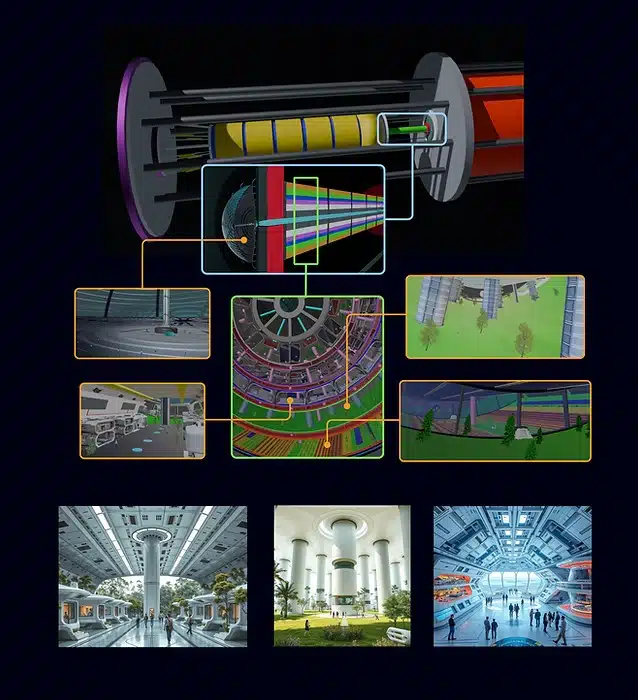
The Ship’s Interior Would Rotate To Produce Artificial Gravity. Credit: Giacomo Infelise, Veronica Magli, Guido Sbrogio’, Nevenka Martinello, Federica Chiara Serpe, Project Hyperion
Radiation protection is addressed through the use of water shielding, with large ???? reservoirs integrated into the outer layers of the structure. These reservoirs absorb high-energy particles from space, reducing exposure to harmful radiation while also serving as a resource for the onboard ecosystem.
The scale of Chrysalis presents significant engineering challenges. The structure cannot be launched from Earth due to its size and mass. Instead, the concept proposes assembling the spacecraft in space, potentially at a gravitationally stable location such as the Earth-Moon L1 Lagrange point. These regions, defined by balanced gravitational forces, allow large structures to maintain position with relatively low energy requirements.
Material sourcing is another key consideration. The design explores the use of lunar or asteroid-derived resources to reduce reliance on Earth-based launches. For propulsion, the concept suggests nuclear thermal systems capable of sustaining interstellar travel over long durations.
Beyond engineering, the proposal addresses the social and organizational structure required for a multi-generational mission. With no possibility of return to Earth, the inhabitants would form a closed society where governance, education, and knowledge transfer must remain stable across generations. The design incorporates educational facilities, research areas, and communal spaces to support continuity and adaptability.
Automation also plays a role in maintaining the spacecraft. Robotic systems are envisioned to handle external repairs and inspections, reducing risk to human occupants. Artificial intelligence systems would assist in managing complex operations and decision-making processes over time.
The Chrysalis concept reflects ongoing efforts within the scientific and design communities to explore the practical and societal requirements of interstellar travel. While the proposal remains theoretical, it highlights the scale of technological, ecological, and human challenges involved in sustaining life far beyond Earth.


