

A new study suggests our eyes can perceive much finer detail than earlier estimates, but not necessarily in ways that make ultra-high-resolution TVs worth the cost. According to ScienceAlert, these findings come from researchers at the University of Cambridge working with Meta Reality Labs.
The team set out to measure the true resolving power of the human eye using modern display technology rather than the 19th century Snellen eye chart. They tested 18 volunteers, aged 13 to 46, using high precision visual patterns shown in different colors, distances, and viewing angles. If the viewer could distinguish fine lines in the patterns, it meant their eyes could resolve detail at that pixel density.
The results show that the human eye can perceive more detail than the long-accepted benchmark of 60 pixels per degree. In gray, the resolution limit reached 94 pixels per degree, and in red and green it was around 89. In yellow and violet, however, the limit dropped sharply to around 53 pixels per degree. The variation comes from how the retina and the brain process different wavelengths of light.
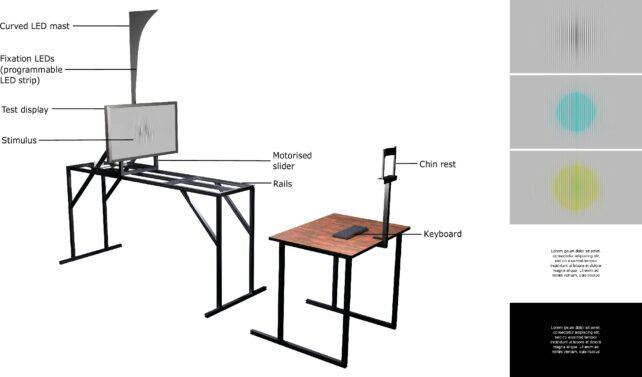
The experimental set-up, and a sample of the visual patterns (right) viewers were presented with. (Ashraf et al., Nat. Commun., 2025)
This finding also explains why ultra-high-definition TVs may offer diminishing returns. At typical living room distances, most viewers cannot resolve all the pixels in a 4K or 8K TV of average size. In practice, a 44-inch 4K or 8K screen often looks no different from a 2K screen unless you sit unusually close.
The researchers argue that display makers might benefit from designing screens around what the vast majority of people can actually see, rather than chasing ever-higher resolutions that human vision cannot fully use. They also demonstrated that applying filters to adjust images for how the retina views them can improve clarity more than simply adding pixels.
The study also highlights the limits of color perception. Our eyes are not great sensors on their own; much of what we think we see is reconstructed by the brain, which struggles with color detail, especially in peripheral vision.
These results underline a larger point: human vision evolved to be good enough for survival, not to match the precision of modern screens. The research appears in Nature Communications.


