

Tesla has officially announced the upcoming launch of the Model YL, a stretched, 6-seater version of its best-selling electric SUV, the Model Y. It is targeted at the Chinese market and scheduled for release this fall.
The announcement came through Tesla’s Weibo account, timed with the vehicle’s appearance on China’s Ministry of Industry and Information Technology (MIIT) website for regulatory approval. The filing reveals a wealth of technical details, allowing us to compare the Model YL to the standard Model Y currently available.
The Model YL is noticeably larger than the standard Model Y, measuring 4976 mm in length, which is roughly 180 mm (7 inches) longer. It maintains the same width at 1920 mm, but stands 24 mm taller at 1668 mm. The wheelbase has been stretched from 2890 mm to 3040 mm, providing a more spacious cabin, likely to support its new six-seat configuration.
In terms of overhangs, the front remains unchanged at 896 mm, while the rear overhang increases slightly from 1011 mm to 1040 mm. The front track widens from 1636 mm to 1656 mm, while the rear narrows just a bit from 1636 mm to 1624 mm.
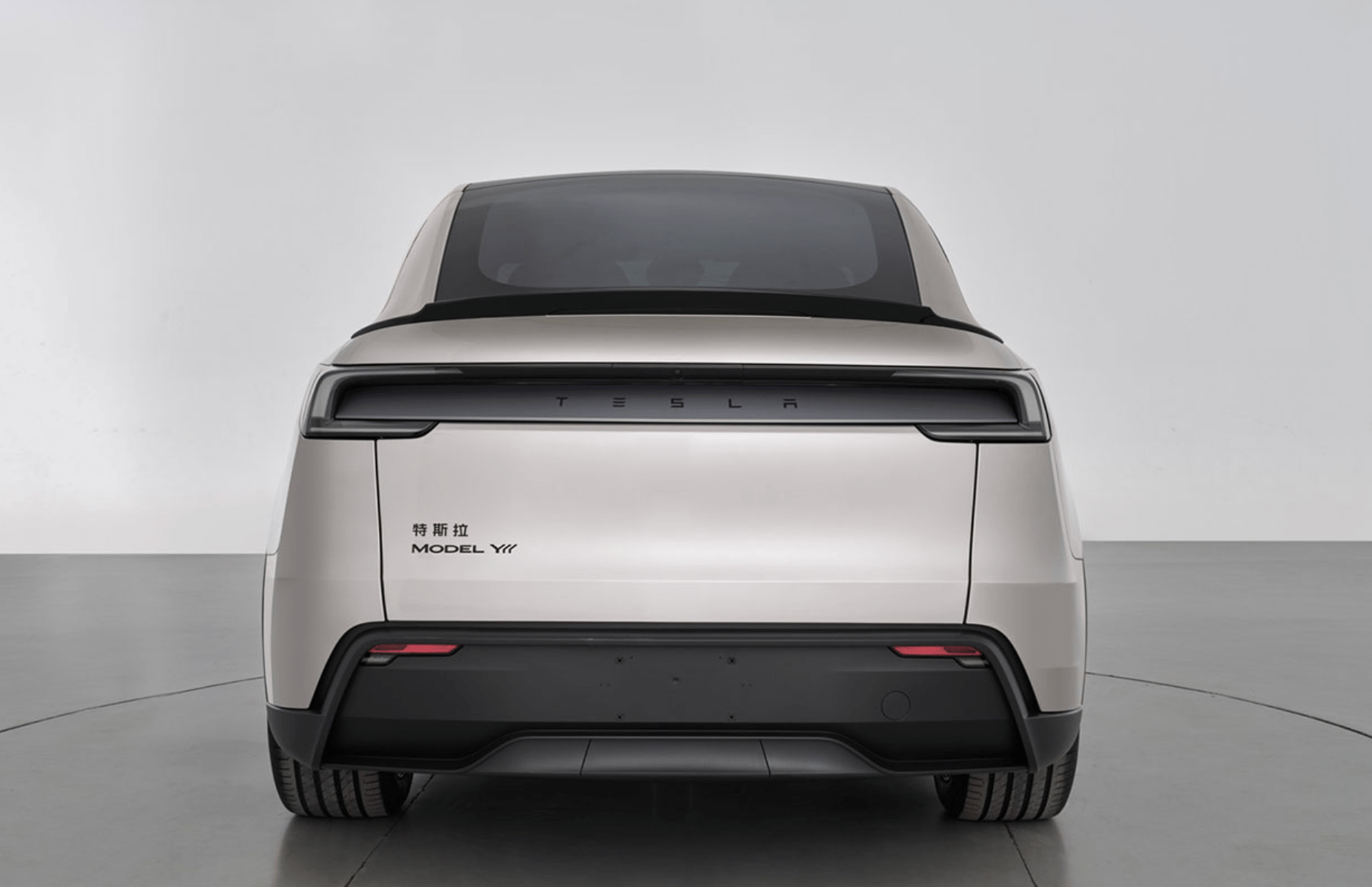
Despite these size increases, the top speed remains the same at 201 km/h. However, the curb weight rises from 1921 kg to 2088 kg, reflecting the larger body, additional seating, and possibly more complex internal hardware.
The Model YL offers updated tire sizes, moving from a standard 255/45R19 or 255/40R20 configuration to a more robust 255/45R19 at the front and 275/45R19 at the rear.
Under the hood (figuratively speaking), the standard Model Y is powered by a 220 kW motor, whereas the Model YL adopts a dual-motor configuration with outputs of 142 kW and 198 kW, indicating an all-wheel-drive setup.
Battery chemistry also differs between the two variants. The standard Model Y uses an LFP (Lithium Iron Phosphate) battery sourced from CATL, while the Model YL will use an NCM (Nickel Cobalt Manganese) battery supplied by LGES Nanjing suggesting a focus on higher energy density and potentially longer range.


