

A university student has created a fully functional operating system using AI coding tools, producing software that boots on ARM64 hardware and runs inside an emulator in just a few weeks. The project, called VibeOS, was developed by computer engineering student Kaan ?enol as reported by MyBroadband.
?enol, who studies at the Polytechnic University of Turin, relied primarily on Anthropic’s Claude large language model to generate the system’s code. The OS successfully runs on a Raspberry Pi Zero 2W and in QEMU’s aarch64 emulator. Despite having no formal background in systems programming, he built a graphical desktop environment, a Python runtime, a C compiler, core Linux utilities, a text editor, an image viewer, a music player, and even managed to run Doom.
The entire OS was produced across 64 Claude sessions using the Claude Max 5x subscription plan, supplemented by Google’s Gemini Pro for additional debugging. Every interaction was logged and preserved in a GitHub repository, creating an unusual development trail that shows the AI progressively constructing components from the kernel upward.
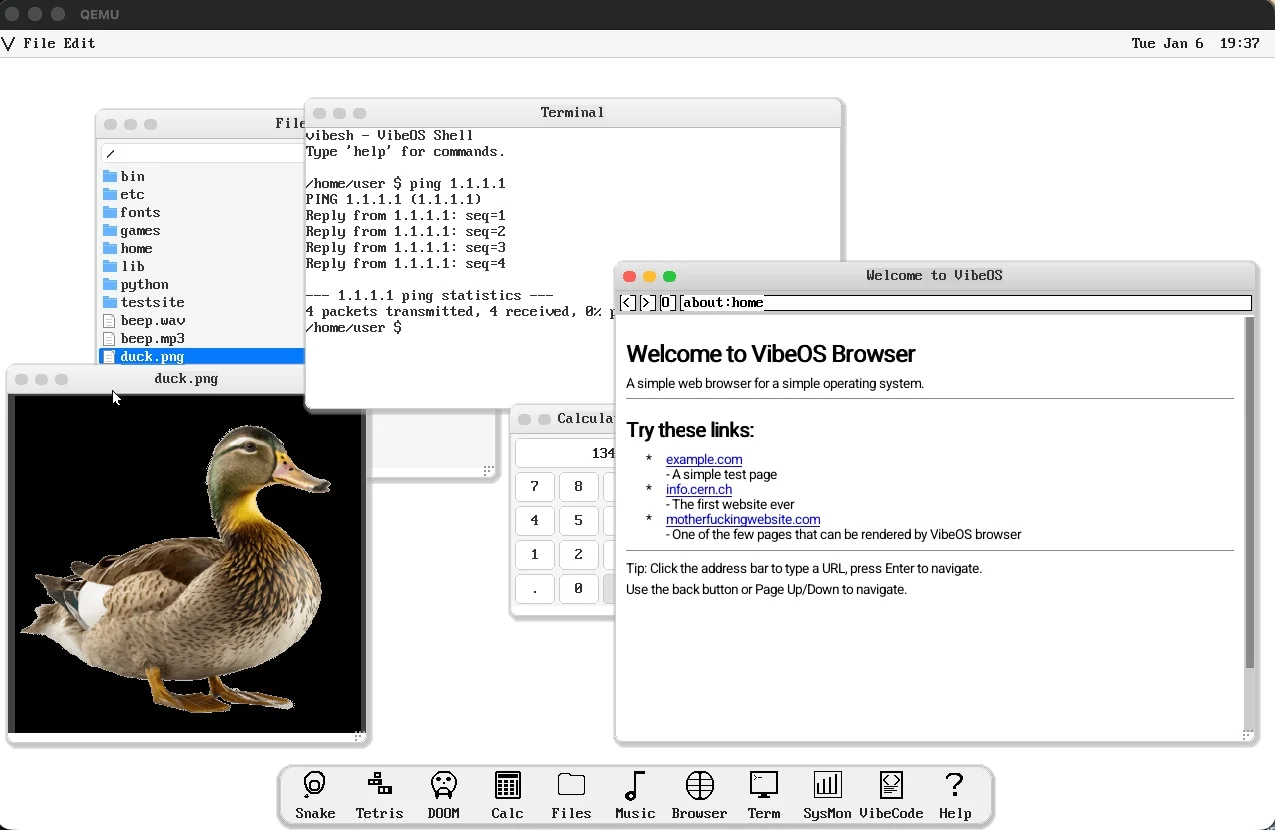
Courtesy: MyBroadband
This style of AI driven development is commonly called “vibe coding,” a term popularized by Andrej Karpathy. Under strict definitions, vibe coding involves minimal human code editing, with the AI generating, revising, and troubleshooting autonomously. ?enol told MyBroadband that his experiment wasn’t purely hands off, but emphasized that he personally wrote no code and mainly guided Claude by breaking problems into smaller steps.
The project also revealed practical limitations of current AI models. Claude struggled with long context management, often forgetting earlier architectural decisions. To counter this, ?enol fed the AI detailed session logs to maintain continuity. In some cases, he intentionally “motivated” the model by having it review prior progress before tackling harder tasks.
Networking only functions in QEMU because the Raspberry Pi version currently lacks Wi Fi support, as tested by MyBroadband. The OS has no memory protection or system call isolation, meaning any application can overwrite anything in memory. While the browser can render basic text pages, modern websites crash the system entirely.
Even with these weaknesses, the achievement underscores how rapidly AI assisted development is advancing. Tasks that traditionally require large teams and years of low level programming were compressed into weeks by a single individual using language models as collaborators.
VibeOS remains a prototype rather than a secure or production ready platform, but it demonstrates a shift in how foundational software could be built in the future. As AI tools mature, projects once considered out of reach for solo developers may increasingly become feasible experiments rather than distant ambitions.


