
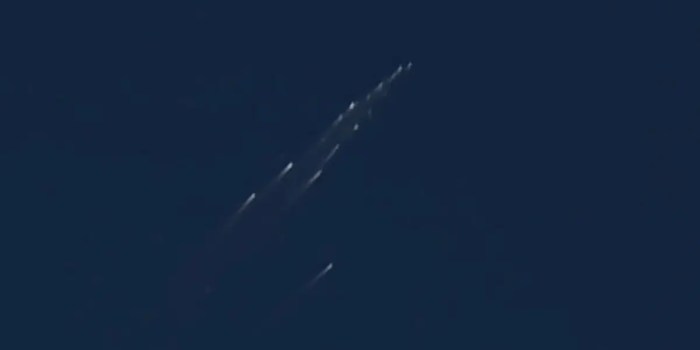
Image Courtesy: University of Stuttgart
Scientists have captured an unusually detailed view of two satellites disintegrating in Earth’s atmosphere, using a research aircraft positioned along their predicted reentry paths. The observations could help researchers understand how spacecraft materials interact with the atmosphere as satellite constellations continue to expand.
The spacecraft, Tango and Samba, were part of the European Space Agency’s former Cluster mission, which studied interactions between Earth’s magnetic field and the solar wind. After roughly 25 years in orbit, the satellites were deliberately directed into controlled reentries over the southern Pacific Ocean near Tonga on August 31 and September 1, 2026.
Researchers boarded a small business jet carrying 30 cameras and spectrometers equipped with specialized filters. Flying above clouds allowed the team to observe the spacecraft from roughly 120 kilometers, or 75 miles, away while recording both the physical breakup and chemical signatures produced during reentry.
The satellites entered the upper atmosphere at about 36,000 kilometers per hour, or 22,370 mph. As atmospheric friction slowed and heated them, their structures began to vaporize and eventually broke apart in sudden, bright flashes.
Ji?í Šilha, CEO of Slovak company Astros Solutions and one of the researchers aboard the aircraft, said the satellites initially appeared as compact points of light before suddenly disintegrating. The team then tracked dozens of fragments for another 30 to 40 seconds as they continued to ablate through the atmosphere.
The researchers were also looking for evidence of chemical changes caused by burning spacecraft. Satellite structures contain materials including aluminum, titanium and potassium, and scientists are particularly interested in aluminum because it can produce aluminum oxide during atmospheric reentry.
Large-scale satellite constellations operated by companies such as SpaceX, Amazon and Blue Origin could lead to substantially more spacecraft returning through the atmosphere. Scientists are still working to determine how much material these reentries deposit and whether those compounds could eventually influence atmospheric chemistry.
The campaign builds on observations of another Cluster satellite, Salsa, during its controlled reentry in 2024. Data from the latest flights will now be analyzed and compared with existing atmospheric models.
The findings could ultimately help space agencies improve spacecraft design, reentry planning and environmental assessments as the number of satellites in low Earth orbit grows.


