

Hornof, D., Helm, V., de Dios Rodriguez, E. et al. A snapshot of relativistic motion: visualizing the Terrell-Penrose effect. Commun Phys 8, 161 (2025). https://doi.org/10.1038/s42005-025-02003-6
Scientists in Austria have managed to do what once seemed impossible: make the speed of light visible. A team from TU Wien and the University of Vienna created a groundbreaking imaging technique that slows down the apparent movement of light to just two meters per second, allowing it to be photographed as it travels, as highlighted by Popular Mechanics.
The experiment draws on a principle from the Terrell-Penrose effect, a relativistic phenomenon theorized decades ago. At speeds close to light, objects should appear compressed in the direction of travel. However, because photons from different parts of an object reach the observer at different times, the image does not simply shrink — it warps or rotates in unexpected ways. In the Austrian study, scientists set out to make this visual distortion more than just a theory by reproducing it in the lab.
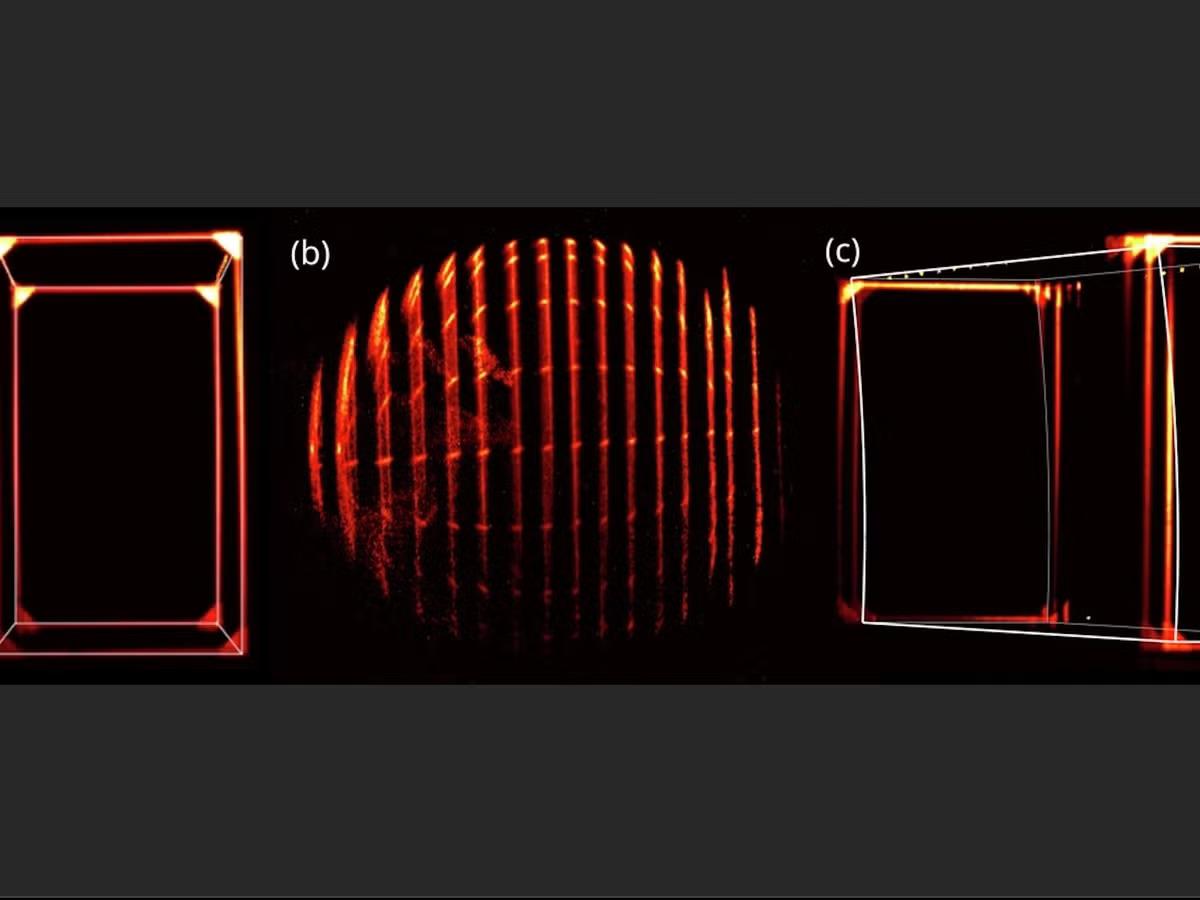
Hornof, D., Helm, V., de Dios Rodriguez, E. et al. A snapshot of relativistic motion: visualizing the Terrell-Penrose effect. Commun Phys 8, 161 (2025). https://doi.org/10.1038/s42005-025-02003-6
To achieve the effect, researchers used ultrafast laser pulses and a highly specialized camera system. By capturing countless delayed slices of reflected light and then combining them, they slowed the visible speed of light dramatically. This made it possible to see objects like cubes and spheres seemingly twist or shift as though they were being filmed while racing at relativistic velocities. A sphere remained round, but with subtle shifts in appearance, while a cube appeared to rotate unnaturally, matching predictions of Einstein’s relativity.
The method doesn’t actually alter the speed of light itself but instead manipulates the way it is observed. According to the researchers, this composite photography could provide new insights into how relativistic motion affects perception. The technique could also find applications in physics education, helping to visualize effects that are usually confined to equations and thought experiments. A detailed breakdown of the approach has also been made available in a paper on arXiv.
The project is part of a growing trend of using advanced optics to turn abstract physics into something tangible. By freezing light into something the human eye can follow, the researchers have opened the door to a new way of experiencing relativity. For now, the images serve as a reminder that even one of nature’s most constant forces can still surprise when seen from a new perspective.


. https://doi.org/10.1038/s42005-025-02003-6 Scientists in Austria have managed to do what once seemed impossible: make the speed of light visible. A team from TU Wien and the University of Vienna created a groundbreaking […]&media=https://wonderfulengineering.com/wp-content/uploads/2025/10/visible-lighit-1.jpg)