

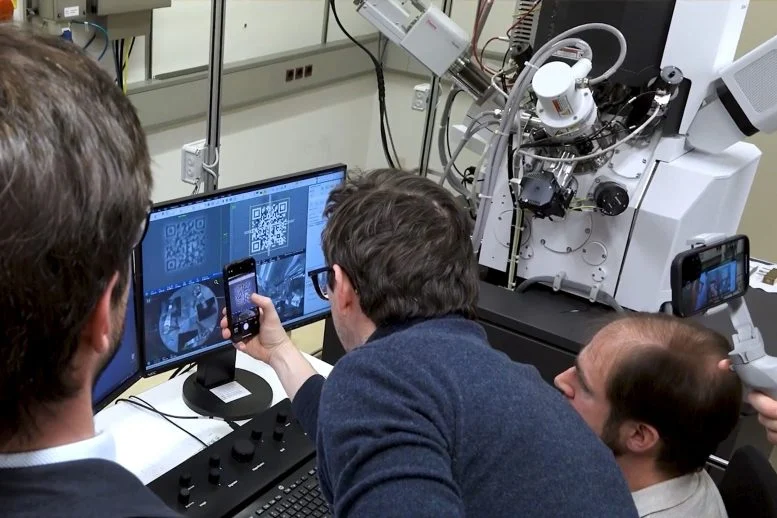
The world’s smallest QR code is only visible with an electron microscope. Credit: TU Wien
Researchers have engineered a QR code so tiny it cannot be seen with a standard optical microscope. Measuring just 1.98 square micrometers, the code is smaller than most bacteria and has now been officially recognized by Guinness World Records as the smallest QR code ever created.
The achievement was made by a team at TU Wien in collaboration with data storage company Cerabyte, who etched the code into a thin ceramic film using focused ion beam technology, according to SciTechDaily. The structure is only visible under an electron microscope, where its intricate pattern can be clearly resolved and read.
Each individual pixel in the code measures just 49 nanometers, roughly ten times smaller than the wavelength of visible light. At this scale, ordinary microscopes cannot detect the pattern at all. However, the breakthrough is not merely about miniaturization. The researchers focused on ensuring long-term stability, a major challenge in ultra-small data encoding.
At microscopic scales, atoms can gradually shift or diffuse, potentially erasing stored information over time. To prevent this, the team used ultra-stable ceramic thin films, materials commonly employed to coat high-performance cutting tools because of their durability under extreme conditions. These ceramics provide an inert and long-lasting medium for data storage.
The implications extend far beyond setting a size record. Traditional magnetic and electronic storage devices often degrade within years and require constant energy, cooling, and data migration to preserve information. In contrast, ceramic-based storage could potentially maintain encoded data for centuries or even millennia without ongoing power.
The researchers estimate that, using this method, more than 2 terabytes of data could theoretically fit on an area the size of a single A4 sheet of paper. That density, combined with long-term durability, positions ceramic thin films as a potential solution for sustainable, energy-free archival storage.
The record-setting demonstration was conducted in front of witnesses and independently verified, marking what the team describes as only the beginning. Future work will focus on increasing writing speeds, scaling manufacturing, and encoding more complex data structures beyond simple QR patterns.


