

The Verge
Nvidia is taking another bold step toward making AI accessible to everyone. The company announced that its new DGX Spark “personal AI supercomputer” will officially go on sale this week, a compact yet immensely powerful machine that puts supercomputing capability right on your desk.
Starting Wednesday, October 15th, the DGX Spark will be available for purchase through Nvidia’s website and select retail partners across the United States. Originally introduced earlier this year with a projected price tag of $3,000, the final retail cost has been adjusted to $3,999, according to details in Nvidia’s official press release. Several major PC makers including Acer, Asus, Dell, Gigabyte, HP, Lenovo, and MSI will also launch their own versions, with Acer’s Veriton GN100 matching the $3,999 price point.
Nvidia describes Spark as a leap toward “democratizing AI.” The system’s small form factor belies its immense power it delivers performance levels once possible only in vast, energy-intensive data centers. At its core is Nvidia’s GB10 Grace Blackwell Superchip, paired with 128GB of unified memory and up to 4TB of NVMe SSD storage. According to Nvidia, Spark can achieve a petaflop of AI performance that’s one quadrillion calculations per second and can handle AI models with up to 200 billion parameters.
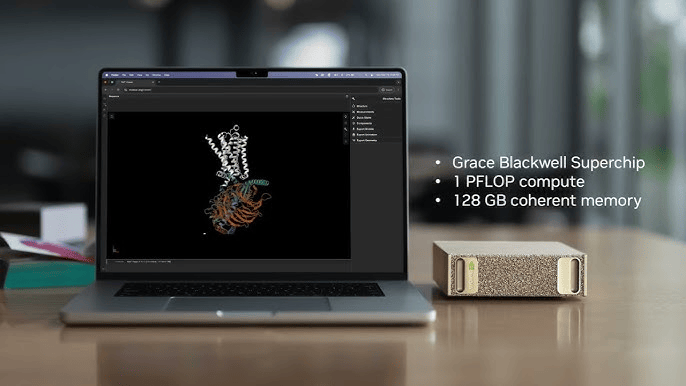
At its debut (when it was known as Digits), Nvidia CEO Jensen Huang described his vision succinctly: “Placing an AI supercomputer on the desks of every data scientist, AI researcher, and student empowers them to engage and shape the age of AI.”
That vision has now materialized. During CES 2025, Huang showcased a prototype of the Spark, emphasizing its potential to bring professional-grade AI computing out of exclusive labs and into classrooms, studios, and homes.
Nvidia proudly calls Spark “the world’s smallest AI supercomputer,” highlighting its ability to operate from a standard wall outlet no specialized power setup required. Despite its miniature footprint, the device represents a monumental shift in how developers and researchers can train and experiment with AI models.


