

The US Navy’s long-rumored F/A-XX sixth-generation fighter is beginning to take shape, and for the first time the public has a glimpse of what it might look like. Northrop Grumman has quietly unveiled a concept image of its design for the carrier-based jet.
Like the Air Force, the Navy is pushing to acquire a sixth-generation fighter. But rather than rely on a carrier-based adaptation of the Air Force’s NGAD program, the service has long argued that it needs a dedicated aircraft suited to its own mission profile. The Navy’s requirements differ in key ways: while the Air Force prioritizes air superiority, the Navy focuses heavily on surface warfare, striking ships and land targets. With China’s expanding influence in the Pacific, longer-range, carrier-capable fighters are viewed as essential for maintaining strategic reach.
Still, the F/A-XX program faces a rocky path. In defense budget debates, it is frequently described as a “sacrificial lamb,” with some in Congress questioning whether the country can justify two separate next-generation fighter programs when drone warfare is taking on a larger role. Despite the skepticism, Northrop Grumman appears determined to show it remains a strong contender, standing alongside Boeing in the race for the contract.
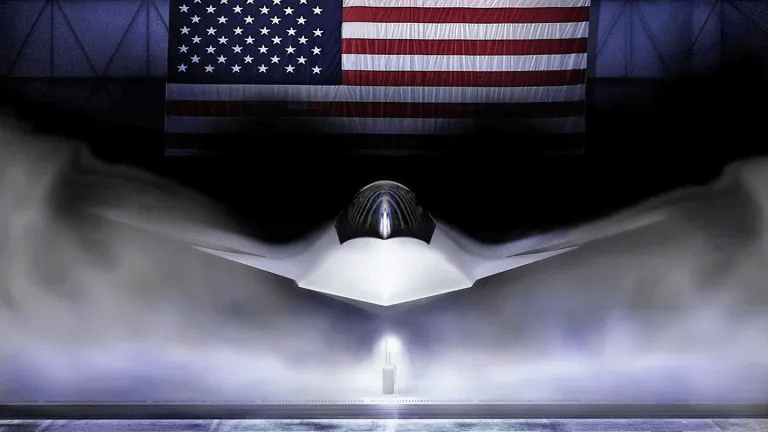
The image released on the company’s Naval Aviation webpage depicts only the forward section of the aircraft, yet even this partial view reveals significant design details. The nose and fuselage lines resemble Northrop’s earlier YF-23 prototype, with a sharp profile and prominent chine optimized for stealth. A top-mounted air intake further reduces its radar visibility, while the proportions suggest ample interior space for fuel and weapons storage. Reinforced twin landing gear points to its readiness for the harsh demands of carrier landings.
Intended to replace the Navy’s current F/A-18E/F Super Hornet and EA-18G Growler, the F/A-XX is envisioned as a stealthy, long-range, multi-role fighter. Though official specifications remain under wraps, defense insiders expect it to offer roughly 25 percent more range than the F-35C, extending its reach to about 837 nautical miles. It will be able to refuel in the air from the MQ-25 Stingray tanker drone, operate at higher speeds than today’s fighters, and incorporate advanced sensors, AI-driven networking, and the ability to coordinate with unmanned systems through manned-unmanned teaming, sometimes called Loyal Wingmen.
If the program continues to be funded, the Navy expects to choose a design by 2028, paving the way for the F/A-XX to enter service in the 2030s.
Source: Northrop Grumman


