

NASA has concluded a ten year research collaboration involving its humanoid robot Valkyrie, which spent a decade at the University of Edinburgh undergoing development and testing aimed at improving robotic mobility and autonomy for future space missions. After completing the program, the robot has returned to NASA’s Johnson Space Center in Texas.
The robot was originally sent to Edinburgh in 2016 as part of a joint robotics research initiative between the University of Edinburgh and Heriot Watt University. Over the following decade, researchers worked on improving Valkyrie’s movement, perception, and control systems to support the development of humanoid robots capable of assisting astronauts in space exploration missions, according to The Debrief.
Valkyrie was designed by NASA as a humanoid robotic platform intended to perform tasks in environments designed for humans. The robot stands approximately 1.8 meters tall and weighs about 126 kilograms. Its human like structure allows it to use tools, operate equipment, and navigate infrastructure built for astronauts in habitats or research stations.
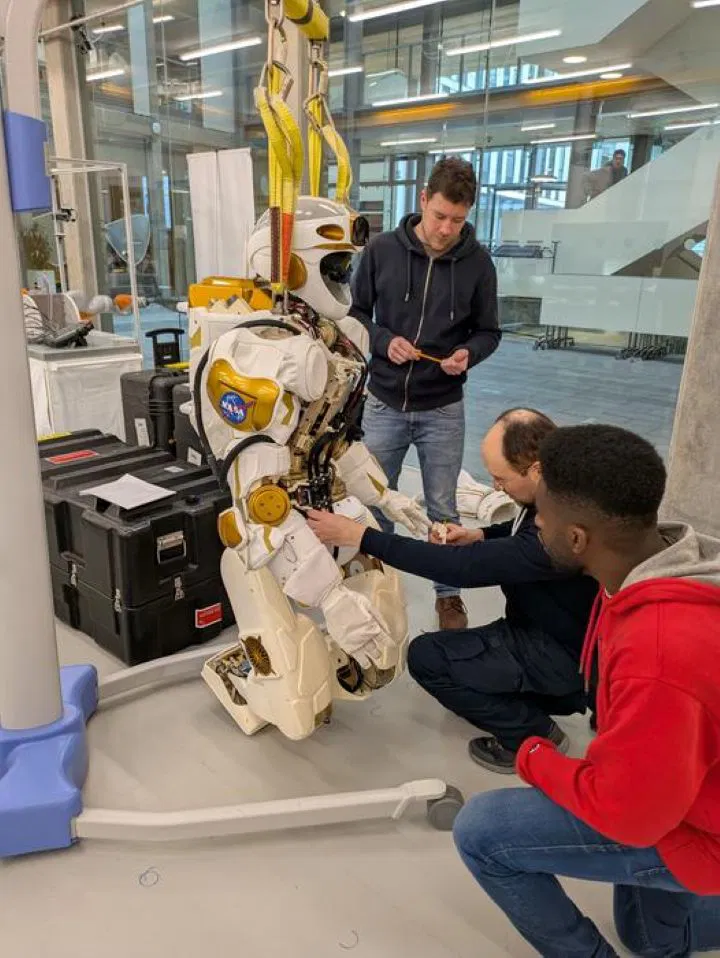
The system includes a set of Series Elastic Actuators, a type of actuator designed to provide precise movement control while maintaining safe interaction with humans. These components allow the robot to perform tasks that require both strength and controlled motion, which is important for operating in confined or hazardous environments.
When the robot first arrived at the Edinburgh Centre for Robotics, its capabilities were limited. Valkyrie could walk only on flat surfaces and perform basic manipulation tasks such as holding objects. Over time, researchers upgraded the robot’s control algorithms, sensor processing systems, and reasoning capabilities using machine learning based software.
These improvements allowed Valkyrie to better interpret data from its sensor array and respond more effectively to changing surroundings. Researchers also improved the robot’s balance and locomotion systems, enabling it to walk on uneven or unpredictable terrain.
Mobility on irregular surfaces is considered an important requirement for robotic systems intended to operate on planetary surfaces such as the Moon or Mars. Engineers used the platform to study motion planning, stability control, and adaptive walking strategies that could allow robots to function in low gravity or unfamiliar environments.
The decade long research program also contributed to improvements in perception systems that help robots recognize obstacles and understand their surroundings. Faster decision making and improved environmental awareness allowed the robot to perform more complex tasks within realistic time constraints.
Although Valkyrie itself is unlikely to travel to space, researchers say the work carried out during its time in Edinburgh influenced the design of newer robotic systems being developed for exploration missions. The research also helped advance broader fields of humanoid robotics and autonomous systems.
During the program, dozens of doctoral students and engineers contributed to the development of algorithms related to locomotion, manipulation, and human robot interaction. The project also helped establish the University of Edinburgh as a major center for robotics research.
Researchers at the Edinburgh Centre for Robotics have continued their work using a newer humanoid robot platform called Talos, which arrived in 2020. The new system is being used to explore advanced balance control, tool use, and machine learning techniques that allow robots to adapt to rapidly changing environments.
Engineers say the long term goal is to develop robotic systems capable of assisting astronauts by performing hazardous tasks, maintaining infrastructure, and supporting scientific operations during future space missions.


