

NASA scientists say Earth remains vulnerable to thousands of large asteroids that have never been detected, highlighting a major gap in planetary defense systems that could leave humanity unprepared for a future impact.
At a major scientific conference this month, NASA’s acting planetary defense officer Kelly Fast revealed that astronomers have only identified about 10,000 near-Earth asteroids larger than 140 meters, even though models estimate roughly 25,000 exist. That means around 15,000 potentially dangerous asteroids remain unlocated in space, according to Newsweek.
These objects are large enough to cause regional devastation if they struck Earth. A single asteroid of this size could release energy equivalent to hundreds of nuclear explosions, flattening an entire city or triggering massive tsunamis if it hit the ocean.
The biggest challenge is not that these asteroids are about to hit Earth, but that scientists do not know where many of them are. Many approach from directions near the Sun, where traditional telescopes cannot see them due to glare. Others are dark and reflect very little sunlight, making them nearly invisible to conventional observation methods.
NASA’s estimates are based on statistical modeling. Scientists analyze the rate at which asteroids are discovered and use those patterns to predict how many remain undiscovered. Based on this data, researchers believe they have found only about 40 percent of the potentially hazardous asteroid population in this size range.
NASA has already demonstrated that asteroid deflection is possible. In 2022, the agency’s DART mission successfully altered the orbit of a small asteroid by crashing a spacecraft into it. The experiment proved that kinetic impact could redirect a dangerous object, but only if scientists detect the threat years in advance. Currently, no such deflection system is ready for immediate deployment.
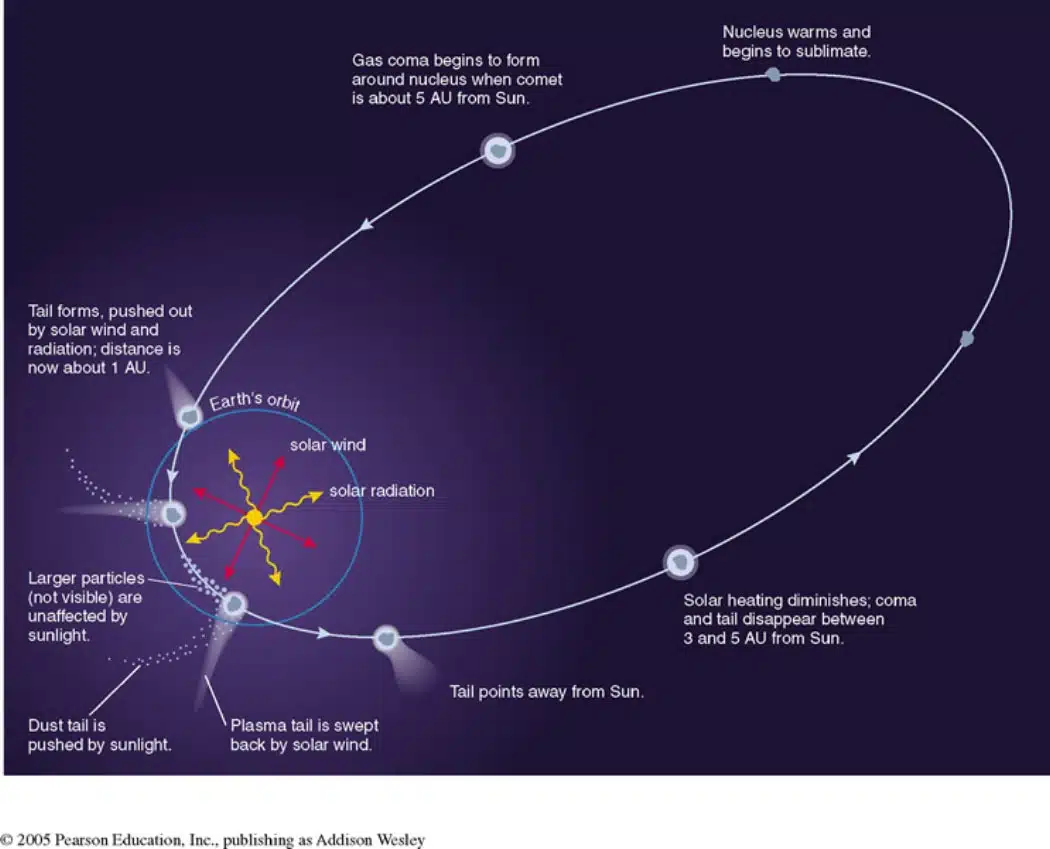
Evolution of a Comet in its Orbital Path. Courtesy: 2005 Pearson Education, Inc.
To close the detection gap, NASA is developing a new space-based infrared telescope called NEO Surveyor, scheduled for launch in 2027. Unlike ground telescopes, it will detect asteroids by sensing heat rather than reflected sunlight, allowing it to find objects hidden in solar glare. The mission is expected to identify up to 90 percent of hazardous asteroids within a decade.
Ground observatories are also improving asteroid tracking. The Vera C. Rubin Observatory in Chile, which became operational in 2025, is scanning the night sky continuously to discover new objects and refine asteroid catalogs.
Despite the alarming numbers, scientists emphasize there is no known asteroid currently on a collision course with Earth. Statistically, impacts from asteroids larger than 140 meters occur only once every 20,000 years on average.
Still, researchers say detection is critical. Without knowing where these asteroids are, humanity would have no warning and no time to respond. NASA and international space agencies are now racing to find these hidden objects before one finds Earth first.


