

Lockheed Martin’s subsidiary Sikorsky is pushing the boundaries of aviation design with its newly unveiled Nomad family of Uncrewed Aerial Systems (UAS) – a line of drones that merge the agility of helicopters with the range and efficiency of fixed-wing aircraft.
This innovation is powered by a concept known as the rotor blown wing. If the term “rotor blown wing” sounds like something out of an aerospace engineer’s daydream, that’s because it practically is but Sikorsky has made it real. The idea involves mounting twin rotors on an extended wing so that their airflow passes directly over the wing’s surface. This creates extra lift during vertical takeoff and hover, while also smoothing the transition to forward flight.
In effect, the rotor blown wing lets an aircraft take off and land like a helicopter but cruise like a plane delivering both vertical lift and high-speed efficiency. What makes this design even more exciting is its scalability, meaning it can be adapted for aircraft of vastly different sizes and missions.
Sikorsky’s Nomad series is built on this hybrid principle. The company describes it as an entire “family” of rotor-blown wing aircraft, designed to serve multiple purposes from military intelligence and surveillance (ISR-T) to contested logistics resupply, light attack missions, maritime patrol, and persistent communications.
Beyond defense, the same aircraft can perform civilian and humanitarian operations, such as search and rescue (SAR), forest fire monitoring, pipeline surveillance, and emergency medical delivery. Thanks to their VTOL (Vertical Takeoff and Landing) capability, these drones can operate from remote or improvised locations, no runway required.
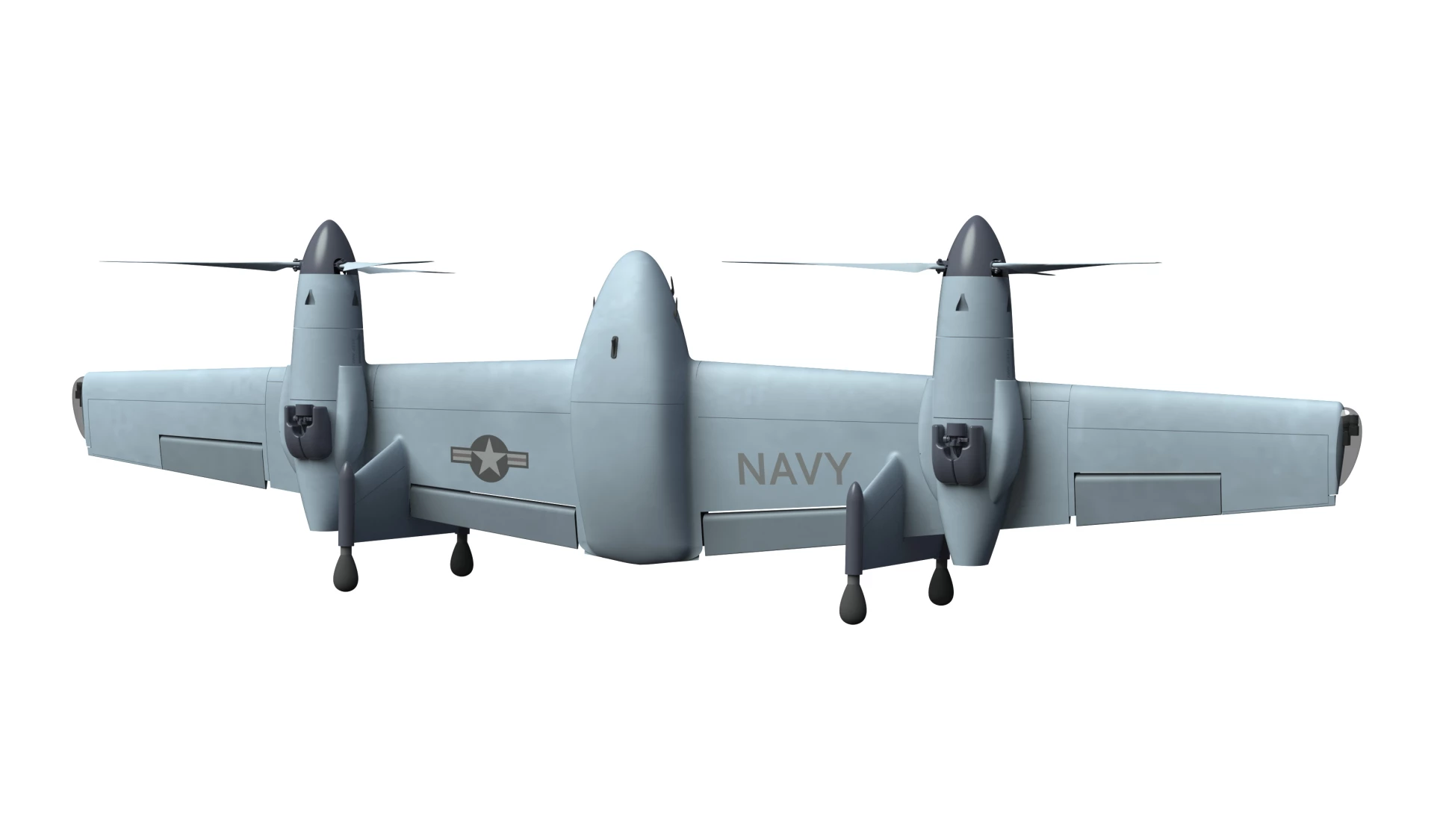
According to Sikorsky, the Nomad family will include both small and large models. The Group 3 versions, small to medium-sized drones up to 1,320 pounds (599 kg) will be followed by Group 4 and 5 aircraft roughly comparable in size to the UH-60 Black Hawk helicopter.
The smallest member, the Nomad 50, has already taken flight. With a 10.3-foot (3.14-meter) wingspan and a 115-pound (52-kg) frame, this prototype serves as proof of concept for the design. It will soon be joined by the Nomad 100, boasting an 18-foot (5.5-meter) wingspan, with larger models already in development.
The smaller Nomads will run on hybrid-electric powertrains, while larger variants will use conventional engines. Each drone will integrate Lockheed Martin’s Matrix digital co-pilot, an autonomous system capable of handling every stage of flight from takeoff and navigation to landing while avoiding obstacles and threats in real time.
Sikorsky emphasizes that the Nomad line isn’t just a single platform but a modular concept adaptable to diverse mission sets and environments. As Rich Benton, Sikorsky’s vice president and general manager, explained:
“We use the term ‘family’ to point to a key attribute of the design; its ability to be scaled in size from a small Group 3 UAS to the footprint equivalent of a Black Hawk helicopter.”
He added that the Nomad aircraft will be “adaptable, go-anywhere, runway-independent platforms” capable of operating across defense, security, forestry, and civilian sectors.


 – a line of drones that merge the agility of helicopters with the range and efficiency of fixed-wing aircraft. This innovation is powered by a concept known as the rotor blown wing. If […]&media=https://wonderfulengineering.com/wp-content/uploads/2025/10/lockheed-nomad.webp)