

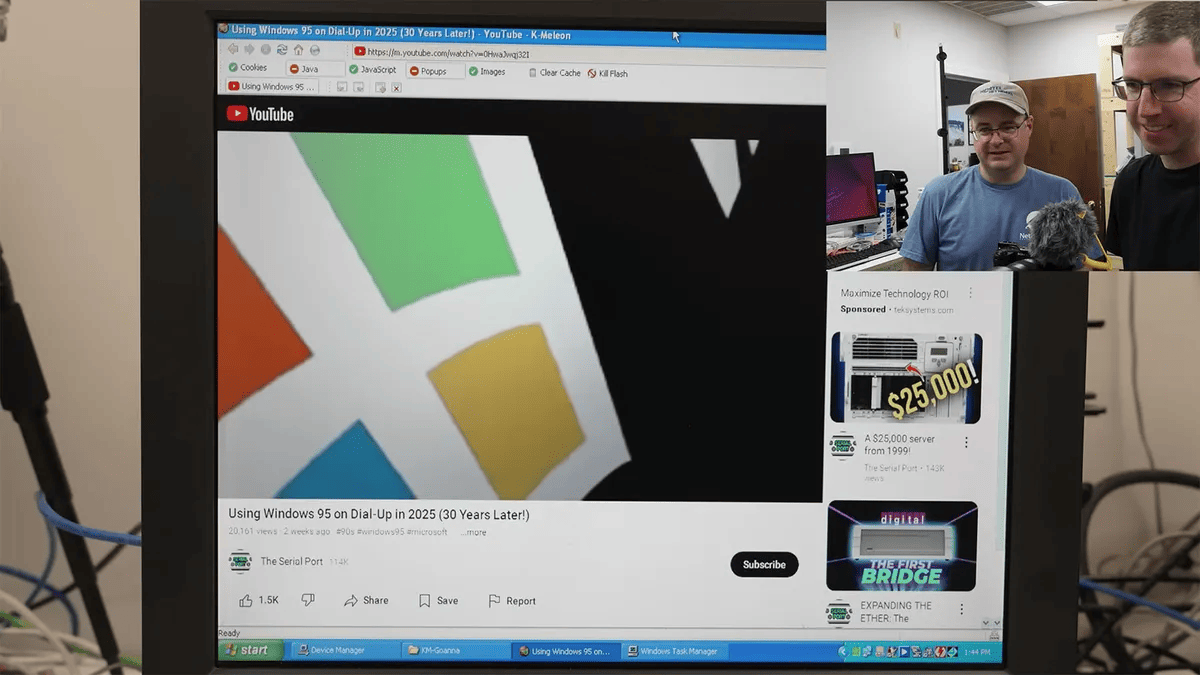
The tech nostalgia channel The Serial Port has done what once seemed absurd: successfully streaming YouTube videos using bonded 56K dial-up modems. In their latest episode, the team managed to stitch together enough old-school hardware to achieve download speeds of 668.8 kbps, fast enough to watch videos on YouTube without stuttering.
The question driving the project was simple: Could dial-up internet, once the bane of impatient households, deliver a modern streaming experience? The answer turned out to be yes but only with some clever engineering.
The setup was built around a Windows XP-era IBM Think Center PC (circa 2004), chosen as a balance between nostalgia and practicality. Into this machine went a Cisco VoIP gateway, two PCI serial expansion cards, and eventually twelve 56K modems. These were bonded using Multilink PPP (MPPP), a networking protocol that combines multiple modem connections into one logical data stream.
Back in the early 2000s, commercial solutions like the Diamond Multimedia Shotgun card tried something similar, letting users bond two modems for faster speeds. But scaling that idea to twelve modems simultaneously? That’s a feat no mainstream consumer ever attempted.
The journey wasn’t smooth. Early tests were conducted on a 2001 IBM desktop running Windows ME, which successfully bonded two modems for a working connection. Encouraged, the team attempted to scale up with an 8-port serial expansion card but driver conflicts killed the idea.
Switching to the slightly newer Windows XP system opened more possibilities. With careful selection of serial expansion cards (to avoid COM port overlaps), the TechTubers eventually maxed out the machine with 13 available serial ports. After tweaking DIP switches, managing tangled phone lines, and enduring countless modem screeches, the system successfully bonded 12 active modems into one massive dial-up pipe.
When tested, the 12-modem array clocked a combined download rate of 668.8 kbps, speeds that would have qualified as “broadband” at the turn of the millennium, when the FCC defined the threshold at just 200 kbps. By modern standards, where 100 Mbps is the new baseline, it’s laughably slow. Yet, on the Windows XP machine, it was enough to stream YouTube at 240p without buffering once the video got going.
Hearing multiple modems dialing simultaneously created a nostalgic symphony of chirps, hisses, and beeps, leaving the YouTubers visibly giddy as they watched their creation crawl into the broadband age.
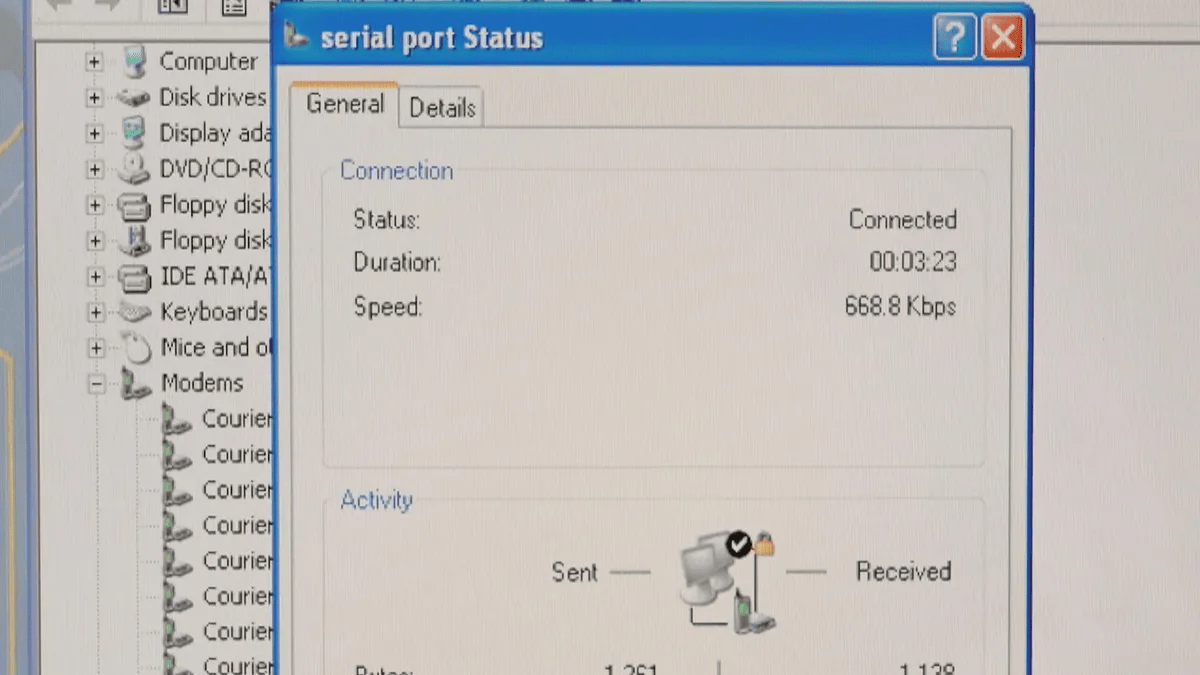
The Serial Port team couldn’t find any evidence of someone bonding more than four modems with MPPP in previous experiments, suggesting that their dozen-modem configuration may be a world record. The official MPPP standard doesn’t actually specify a practical upper limit, so the door remains open for even larger experiments in the future.
While no one in 2025 would trade fiber connections for bonded modems, the project shines a light on both the creativity of tech hobbyists and the historical quirks of internet evolution. In 2000, downloading an MP3 could tie up a phone line for twenty minutes, while Napster, early video sites, and the dawn of online gaming cried out for broadband. Today, gigabit fiber makes such struggles feel like ancient history.
Still, thanks to The Serial Port, dial-up has briefly reentered the streaming age, proving that with enough patience, persistence, and retro hardware, even the impossible is possible.


