

For decades, computer science students have been taught that finding faster routes through networks of roads or data points had already hit a ceiling. Since the 1980s, Dijkstra’s algorithm and its later variations were considered as close to optimal as possible, thanks to what experts called the “sorting bottleneck.” But a team led by Professor Duan Ran at Tsinghua University has now surprised the field with a new method that bypasses this long-standing barrier and has already won recognition at the prestigious STOC conference.
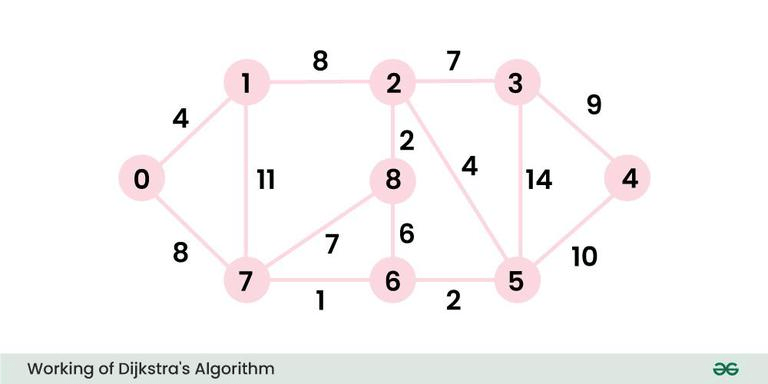
Image Credits: Geeksforgeeks
The sorting bottleneck refers to how traditional shortest-path algorithms rely heavily on sorting nodes to determine the next step. While efficient data structures have made this process faster, sorting has always imposed a natural limit on how much these algorithms can be optimized. Earlier breakthroughs, like Thorup’s algorithm, chipped away at the problem but were still constrained by certain conditions, such as specific graph types or edge weights.
Duan and his team managed to change the rules. Instead of repeatedly sorting every candidate node, they developed a clustering approach. The idea is to group nearby nodes and select a representative “pivot” from each cluster. By prioritizing these pivots, the algorithm avoids unnecessary comparisons and speeds up the process. It may not always examine the absolute nearest node first, but the efficiency gained more than makes up for that compromise.
To handle more complex graphs, especially directed ones with varied edge weights, the researchers incorporated strategies from Bellman–Ford, another classic algorithm. They divided the problem into phases, marking key nodes in advance and then exploring from these anchors. This hybrid method ensured that even when the data was messy or asymmetric, the algorithm still delivered accurate paths without reverting to heavy sorting.
Graduate students in Duan’s lab played a vital role. One of them, Mao Xiao, refined the algorithm by making it fully deterministic. This eliminated the need for randomization, which can complicate real-world applications. Testing confirmed that the new algorithm consistently outperformed established methods, offering both speed and stronger theoretical guarantees.
The potential applications are wide-ranging. Navigation systems could calculate routes faster, communication networks could handle data traffic more efficiently, and logistics planners could optimize deliveries at larger scales than before. For a field that many thought had reached its limit, this discovery is a reminder that foundational problems can still surprise us.
As one expert put it, breakthroughs often feel obvious in hindsight. But it took years of persistence and fresh ideas to finally escape the bottleneck that had constrained shortest-path algorithms for nearly forty years.


